
Gear · Preserve
Preserving — canners, jars, and the tools that make a seal hold
Which canner for which food is decided by one number, not by preference. Plus the three tools that account for most failed seals.
Preserve Tested processes, correct headspace, and jars that are still good next March.
Which canner is not a preference
It is determined by the food’s pH, and the line is 4.6.
| Water-bath canner | Pressure canner | |
|---|---|---|
| Reaches | 212 °F at sea level | 240 °F at 10–11 psi |
| Kills | Moulds, yeasts, most bacteria, botulism toxin | All of that plus botulism spores |
| Valid for | pH below 4.6 | pH 4.6 and above |
| Cost | ~$100 | ~$185 |
Boiling water physically cannot exceed 212 °F, no matter how long you boil. Botulism spores survive it indefinitely. That is why “I water-bathed it for three hours instead” is not a safety argument — duration cannot substitute for temperature.
For the sauces on this site: an acidified tomato sauce and a tested tomatillo salsa are water-bath foods. A low-acid sauce, or anything with meat, needs pressure canning under a tested recipe. Fermented hot sauce, pesto, romesco and zhoug are refrigerator or freezer foods and there is no tested process that changes that. Full explanation here.
The rack is not optional
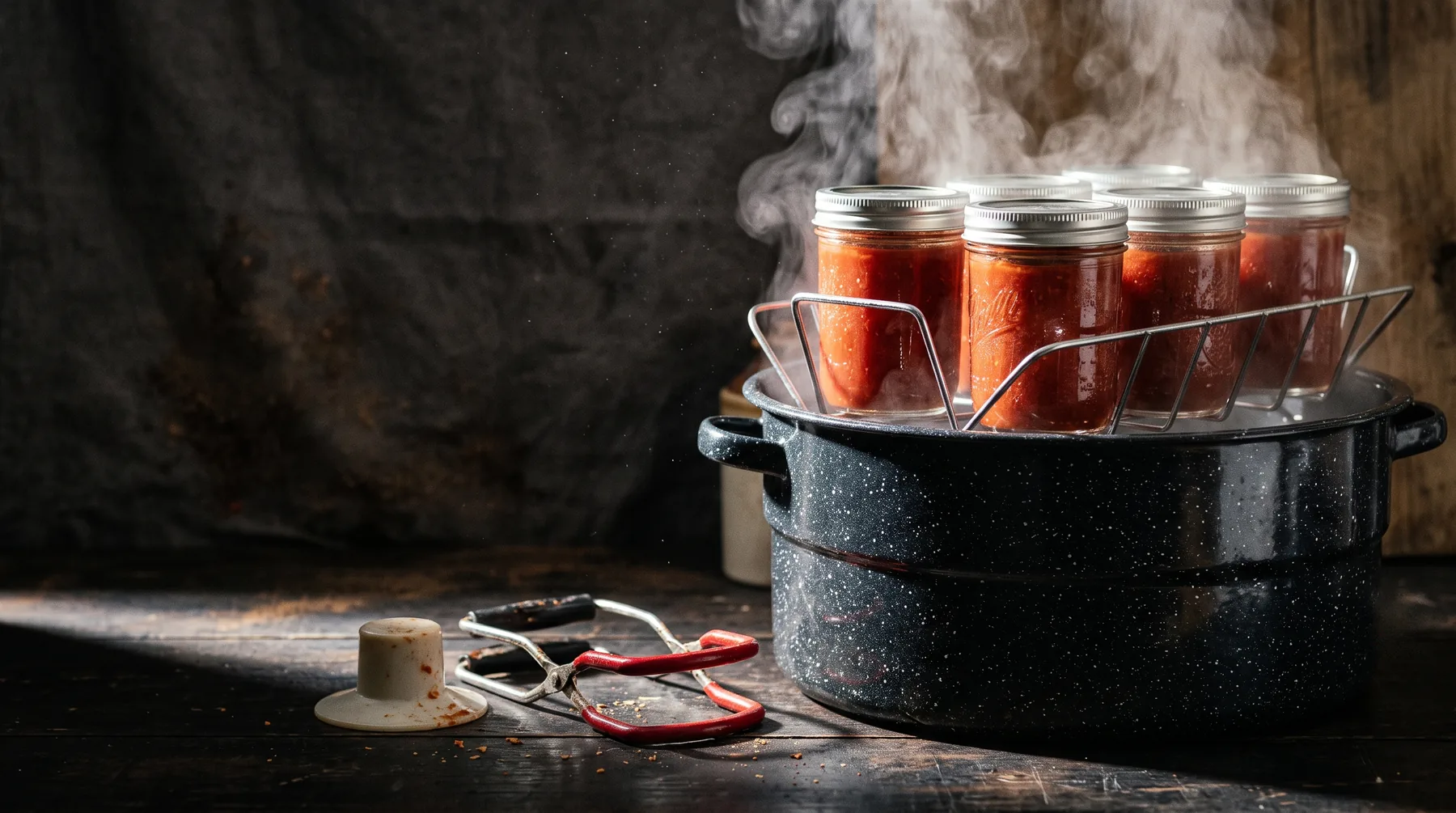
A jar sitting on the pot floor takes direct conductive heat and cracks. Every water-bath canner needs a rack that holds jars off the bottom and lets water circulate underneath. A set that includes it is the simpler purchase.
Pressure canning: follow the process exactly
This is the single most consequential place in home preserving to improvise, and the advice is short:
- Use a tested recipe, at the stated pressure, for the stated time.
- Adjust for altitude. Not optional, and the most commonly skipped step.
- Have dial-gauge canners tested annually by your county extension office.
- A pressure canner is not an electric multicooker. Never pressure-can in one; they are not validated for it and cannot be relied upon to hold temperature.
Jars, lids, and the one consumable
Jars are effectively permanent. Check every rim for chips before filling — a chipped rim will not seal.
Bands are reusable indefinitely.
Flat lids are single-use for canning. The sealing compound is engineered for one heat cycle. Reusing them is the most common cause of a jar that seals on the counter and quietly unseals in November. Buy genuine Ball lids; off-brand compound has a measurably higher failure rate.
Jar size for sauce: half-pints for hot sauce and anything used by the spoonful, pints for marinara — one pint is one dinner. Open a quart of hot sauce and you are racing the fridge.
The three tools that decide a seal
- A jar lifter. A safety tool, not a convenience — you are moving glass full of 212 °F liquid.
- A headspace gauge. Wrong headspace is one of the top causes of seal failure. Half an inch for most sauces, and the gauge removes the guess.
- A wide funnel. Keeps the rim clean. A single speck of sauce on the rim is a failed seal, and this is where most of them come from.
After processing
- Cool undisturbed for 12–24 hours. Do not press the lids.
- Test each seal by lifting the jar by the lid alone. If it holds, it sealed.
- Remove bands for storage — a band can hold a failed lid in place and hide it.
- Label with the contents and the date. In March, three jars of red sauce are indistinguishable, and “probably the one from August” is not a food-safety practice.
- Unsealed jar: refrigerate and use within a week, or re-process within 24 hours with a fresh lid. Never store an unsealed jar at room temperature.
The picks
Granite Ware
9-Piece Enamelware Water Bath Canning Set
Paid link · commission may be earned
Water-bath canning is the tested process for high-acid foods — anything reliably below pH 4.6. The rack is not optional: jars sitting on the pot floor crack from direct heat.
Why this one
- Pot, rack, and the handling tools in one purchase
- Holds 7 quarts or a full load of half-pints
- Enamelware is non-reactive and light enough to lift full of boiling water
The tradeoff
- HIGH-ACID FOODS ONLY. Never water-bath a low-acid sauce — see /guides/canning-acid-math/.
- Processing times must be adjusted for altitude; the pot does not know where you live.
Presto
01781 23-Quart Pressure Canner and Cooker
Paid link · commission may be earned
A low-acid sauce — one that is not reliably under pH 4.6 — cannot be made shelf-stable in boiling water at any duration. Only a pressure canner reaches the 240 °F that destroys botulism spores.
Why this one
- Reaches 240 °F, which boiling water physically cannot
- 23 qt takes a full load of pints
- The reference home pressure canner; parts are available everywhere
The tradeoff
- Follow a tested process exactly. Improvised pressure canning is the single most dangerous thing in home preserving.
- Gauge canners should be tested annually by your extension office
- Not the same appliance as an electric multicooker — never pressure-can in one
PrepWorks
Canning Essentials Set
Paid link · commission may be earned
A jar lifter is a safety tool, not a convenience: you are moving glass full of 212 °F sauce. The headspace gauge is the other half — wrong headspace is the most common reason a seal fails.
Why this one
- Spring-loaded jar lifter that actually grips a wet jar
- Headspace gauge and bubble remover in one tool
- Wide funnel keeps the rim clean, which is what a seal needs
The tradeoff
- Plastic parts; keep them out of the boiling water itself
Ball
Half Pint (8 oz) Regular Mouth Mason Jars, 12
Paid link · commission may be earned
Eight ounces is the right jar for a sauce you use by the spoonful. Open a quart of hot sauce and you are racing the fridge; open a half-pint and you finish it while it is still good.
Why this one
- Correct portion — a sauce is finished before it degrades
- Standard Ball geometry: lids, funnels and racks all fit
- Reusable indefinitely; only the flat lid is a consumable
The tradeoff
- Lids are single-use for canning. Bands and jars are not.
- Check every rim for chips before filling — a chipped rim will not seal
Ball
Pint (16 oz) Regular Mouth Mason Jars with Lids and Bands
Paid link · commission may be earned
The right size for marinara, where a jar is one dinner for a family. Same rules as the half-pints: the glass is forever, the flat lid is not.
Why this one
- One pint is one pasta dinner — no leftovers ageing in the fridge
- Ships with lids and bands
- Standard regular-mouth fittings
The tradeoff
- Lids are single-use for canning
- Regular mouth is harder to fill with a chunky sauce than wide mouth
Ball
Mason Jar Lids, Regular Mouth, 72 count
Paid link · commission may be earned
The flat lid's sealing compound is designed for one heat cycle. Reusing it is the single most common cause of a jar that seals, then quietly unseals in November.
Why this one
- Genuine Ball compound — off-brand lids have a measurably higher failure rate
- 72 count covers a serious canning season
- Fits every regular-mouth jar on this site
The tradeoff
- Single use for canning, every time. No exceptions.
- Do not boil modern lids before use — current Ball guidance is to simmer or just wash
WSICSE
Canning Jar Labels, 360 pcs, removable
Paid link · commission may be earned
Date every jar. In March, three jars of red sauce are indistinguishable, and 'it's probably the one from August' is not a food-safety practice.
Why this one
- Removable adhesive — jars come clean for the next season
- 360 labels covers years
- Writable surface that survives the fridge
The tradeoff
- Label AFTER processing and cooling; adhesive fails in a boiling water bath
MicroEssential
Hydrion Short-Range pH Strips, 0.0–6.0
Paid link · commission may be earned
The budget answer, and a genuinely usable one: a 0–6 range in 0.5 steps tells you whether a ferment has crossed 4.6. Universal 1–14 strips cannot — they are useless for this job.
Why this one
- Short range means readable half-point resolution where it matters
- 15 ft roll in a dispenser — hundreds of tests for the price of a lunch
- No calibration, no batteries, no probe to kill
The tradeoff
- 0.5 pH resolution. Fine for confirming a ferment is well under 4.6; not enough for a reading that lands near it.
- Coloured sauce stains the strip and makes reading harder — test the brine, not the mash
Apera Instruments
AI311 PH60 Waterproof Pocket pH Tester
Paid link · commission may be earned
The 4.6 line is not a guideline, it is the number below which Clostridium botulinum cannot grow. Strips get you to half a pH point. This gets you to ±0.1, and for anything you intend to keep, that difference is the whole ballgame.
Why this one
- ±0.1 pH accuracy with a replaceable probe
- Auto-calibration against standard buffers
- Waterproof body that survives a sauce kitchen
The tradeoff
- Must be calibrated before every session — an uncalibrated meter is worse than strips because you'll trust it
- The probe is a consumable; store it wet in storage solution, never dry
- Real money. If you are only ever going to refrigerate, strips are enough.
As an Amazon Associate I earn from qualifying purchases. Amazon is the seller on every item above; check each listing for current seller, price, and availability. Full disclosure. Reviewed 2026-09-01.