
Guide · preserving
Canning Acid Math: why pH 4.6 is the only number that matters
The single line that separates a water-bath jar from a pressure-canner jar, why you cannot taste it, and what tomatoes do that makes them the most dangerous ingredient in a home kitchen.
There is exactly one number in home canning that is not a matter of preference, technique or family tradition.
4.6
Below pH 4.6, Clostridium botulinum cannot grow. Above it, in an oxygen-free environment at room temperature, it can — and it produces one of the most potent neurotoxins known.
Everything else about home canning is downstream of which side of that line your food sits on.
What the two methods actually do
| Water-bath canning | Pressure canning | |
|---|---|---|
| Temperature reached | 212 °F (100 °C) at sea level | 240 °F (116 °C) at 10–11 psi |
| Kills | Moulds, yeasts, most bacteria, botulism toxin | All of that, plus botulism spores |
| Valid for | High-acid foods: pH below 4.6 | Low-acid foods: pH 4.6 and above |
| Typical foods | Pickles, jams, most fruit, properly acidified tomatoes, tested salsas | Vegetables, meat, stock, low-acid sauces |
Boiling water physically cannot exceed 212 °F at sea level, no matter how long you boil it. Botulism spores shrug that off. The only route to 240 °F in a home kitchen is pressure.
This is why “I water-bathed it for three hours instead” is not a safety argument. Duration cannot substitute for temperature.
Spores are not toxin
This distinction gets lost and it matters:
- Spores are dormant, ubiquitous in soil, and harmless to eat. They survive 212 °F.
- Toxin is what spores produce when they germinate in a low-acid, oxygen-free, room-temperature environment. It is destroyed by 10 minutes at boiling.
A sealed jar of low-acid food at room temperature is an almost perfectly designed incubator: no oxygen, no competition, no acid, warm. That is why the jar is the hazard and the soil is not.
You cannot taste pH
This is the part people resist, so here is the mechanism.
What you perceive as sourness is driven by the sugar-to-acid ratio, not by pH alone. A sweet tomato at pH 4.4 tastes milder than a lean one at pH 4.7 — the more acidic fruit tastes less acidic. Your palate is measuring a ratio; safety depends on an absolute.
Tomatoes: the ingredient that broke the rule
Tomatoes are the reason home canners get into trouble, because they sit directly on the line.
- Historic cultivars mostly came in below 4.6.
- Modern cultivars range roughly pH 4.2 to 4.9.
- Overripe fruit is less acidic, not more.
- Ripening off-vine, cultivar, and season all move the number.
So the USDA requires added acid in all home-canned tomato products, regardless of variety, ripeness or how sharp it tastes:
Per pint: 1 tablespoon bottled lemon juice, or ¼ teaspoon citric acid. Per quart: 2 tablespoons bottled lemon juice, or ½ teaspoon citric acid.
Add it to the jar, before filling. Use bottled lemon juice — it is standardised for acidity, and fresh lemons vary by variety, ripeness and age. When acid is the safety control, a known quantity is the whole point.
Why “tested process” is not bureaucratic language
A tested process is not just a pH target. It is a validated combination of ingredient ratio, jar size, fill temperature, headspace, food density and process time, checked with thermocouples in real jars to confirm the cold spot reaches lethality.
Change any input and the validation no longer applies:
- More onion, garlic or peppers in a salsa raises pH toward 4.6.
- Adding oil, flour or starch slows heat penetration so the centre never reaches temperature.
- Packing it denser does the same thing.
- A different jar size changes the heating curve entirely.
This is why “I made the tested salsa but doubled the peppers” is a different food with an unknown process.
Measuring it
- pH strips, 0–6 short range: 0.5 pH resolution. Adequate for confirming a lacto-ferment at 3.2 is comfortably under the line. Not adequate near 4.6.
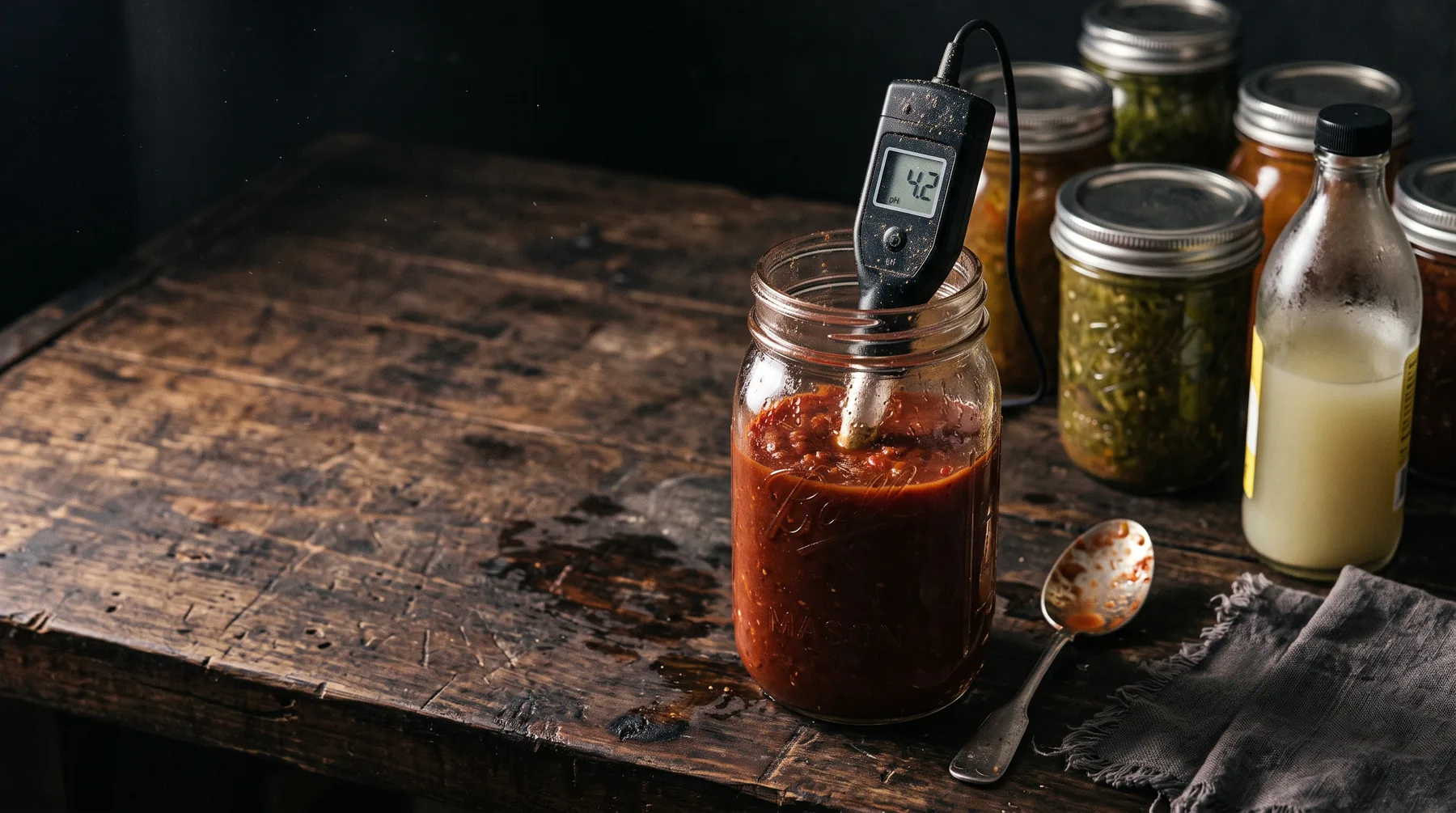
- Calibrated pH meter: ±0.1. Needed for anything near the threshold, and for any product you intend to shelf-store. Calibrate before every session — an uncalibrated meter is worse than strips because you will believe it.
The practical rule
- Reliably under 4.6 by a tested recipe → water bath, at the tested time, altitude-adjusted.
- At or above 4.6 → pressure canner, tested process, altitude-adjusted.
- Anything improvised, dense, oily, or nut- or herb-based → refrigerate or freeze. This covers pesto, romesco, zhoug and most chile pastes, and freezing is genuinely excellent for all of them.
When our page and the NCHFP disagree, follow the NCHFP.
Related crops
Related sauces
Sources
Every food-safety number on this page traces to one of these. If you are going to trust one link on this site, trust these over us.
The gear this guide assumes
AI311 PH60 Waterproof Pocket pH TesterMust have
The 4.6 line is not a guideline, it is the number below which Clostridium botulinum cannot grow. Strips get you to half a pH point. This gets you to ±0.1, and for anything you intend to keep, that difference is the whole ballgame.
AI1113 pH Calibration Buffer Kit (4.00 / 7.00)
A pH meter is only as honest as its last calibration. Two-point calibration at 4.00 and 7.00 brackets the entire range a sauce ever lives in.
Hydrion Short-Range pH Strips, 0.0–6.0
The budget answer, and a genuinely usable one: a 0–6 range in 0.5 steps tells you whether a ferment has crossed 4.6. Universal 1–14 strips cannot — they are useless for this job.
9-Piece Enamelware Water Bath Canning SetMust have
Water-bath canning is the tested process for high-acid foods — anything reliably below pH 4.6. The rack is not optional: jars sitting on the pot floor crack from direct heat.
01781 23-Quart Pressure Canner and Cooker
A low-acid sauce — one that is not reliably under pH 4.6 — cannot be made shelf-stable in boiling water at any duration. Only a pressure canner reaches the 240 °F that destroys botulism spores.
Canning Essentials SetMust have
A jar lifter is a safety tool, not a convenience: you are moving glass full of 212 °F sauce. The headspace gauge is the other half — wrong headspace is the most common reason a seal fails.
Half Pint (8 oz) Regular Mouth Mason Jars, 12Must have
Eight ounces is the right jar for a sauce you use by the spoonful. Open a quart of hot sauce and you are racing the fridge; open a half-pint and you finish it while it is still good.
Mason Jar Lids, Regular Mouth, 72 countMust have
The flat lid's sealing compound is designed for one heat cycle. Reusing it is the single most common cause of a jar that seals, then quietly unseals in November.
Paid links. We earn a commission from Amazon if you buy; you pay the same. Disclosure.
Questions people actually ask
My grandmother canned this way for fifty years and nobody died.
Survivorship bias is not a food-safety method. Botulism is rare in absolute terms — a few dozen cases a year in the US — precisely because most improvised jars happen not to become anaerobic and contaminated at the same time. The consequence when it does is respiratory paralysis. The odds are good and the stakes are catastrophic, which is exactly the shape of risk where you follow a tested process instead of an anecdote.
Can I just add more vinegar to be safe?
For a recipe you are going to refrigerate, more acid is genuinely safer. For a jar you intend to shelf-store, you need a tested process, not a directional adjustment — because process time also depends on the food's density and heat penetration, not just its pH. Acid is necessary and not sufficient.
Does boiling destroy botulism toxin?
The TOXIN is destroyed by boiling for 10 minutes. The SPORES are not — they survive 212 °F essentially indefinitely, which is the entire reason pressure canning exists. Never treat "I'll boil it before eating" as a canning safety plan.
What about altitude?
Water boils below 212 °F as you go up, so a water bath delivers less lethality per minute. Add 5 minutes to water-bath times per 1,000 ft above 1,000 ft, and increase pressure-canner pressure per the tested chart. This is not optional and it is the most commonly skipped adjustment.
Last reviewed 2026-09-01 by the SeedsToSauce Test Kitchen.Corrections welcome.