
Gear · Ferment
Fermentation — airlock, weight, salt, and a way to read pH
Four purchases and one number. Everything that goes wrong in a ferment goes wrong because something floated, or because the salt was measured in spoons.
Ferment Brine percentage, anaerobic conditions, and a pH meter you can trust.
Lacto-fermentation is a competition you rig in advance: salt, no oxygen, falling pH. The gear exists to hold those three conditions steady while you leave it alone for a month.
Airlock lids
CO₂ has to leave. Oxygen must not enter. A sealed jar builds pressure until it fails; an open jar grows mould.
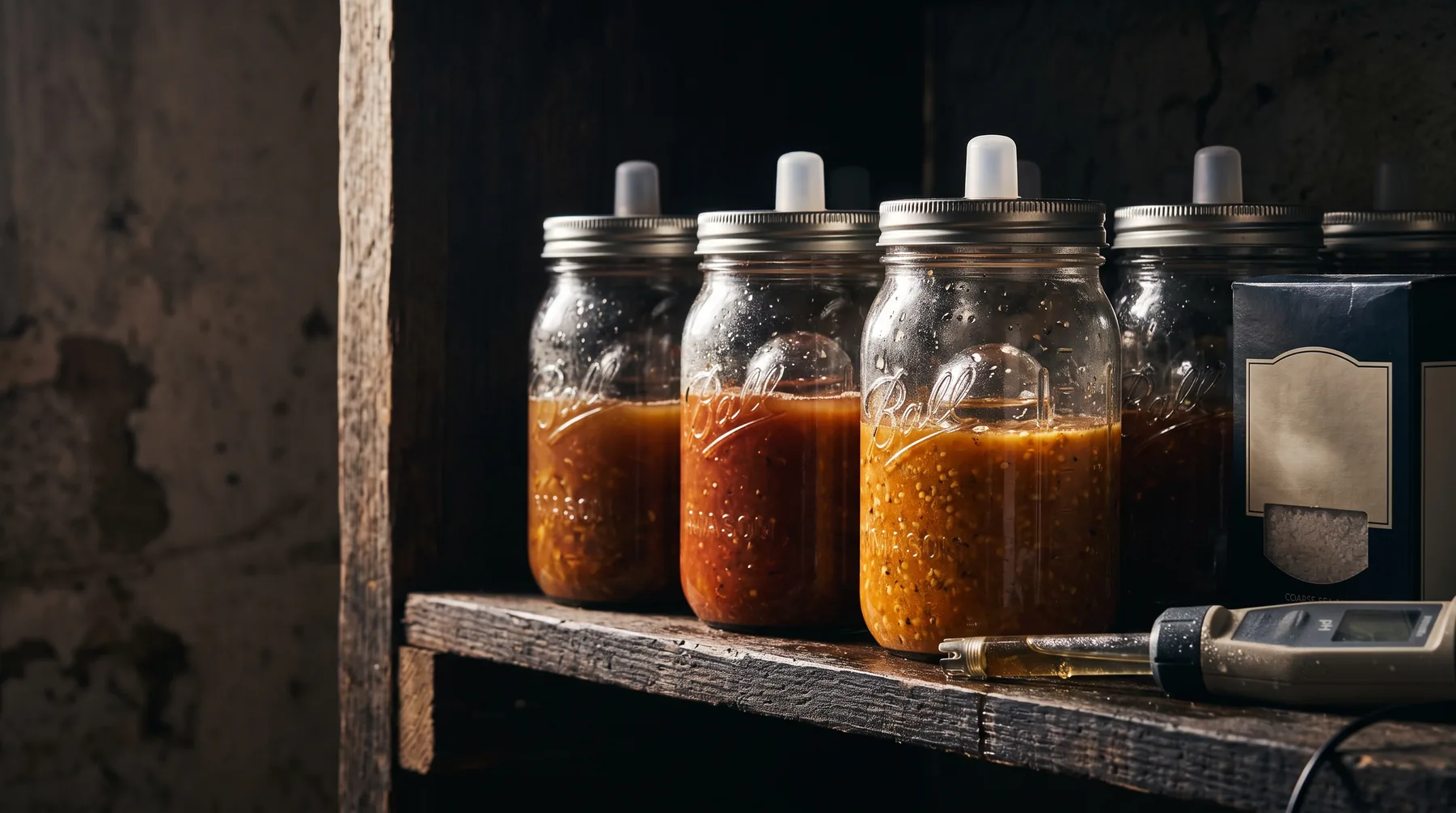
Silicone airlock lids are the simplest answer — nothing to top up, nothing to spill. Three-piece water airlocks work equally well on a larger vessel and need topping up.
Do not open the jar to check on it. Opening it is the risk you are paying the airlock to avoid.
Glass weights — the one that prevents most failures
Almost every failed ferment is a floating-solids problem. Moulds are aerobic: anything above the brine is in air, and it will grow mould, which then colonises downward.
A glass weight holds everything under the brine for a month without you touching it. Fifteen dollars, and it prevents the single most common failure.
Glass specifically, because it is inert — metal reacts with an acid brine.
Vessel size, honestly
Ten pounds of chiles do not fit in a quart jar. A quart is a test batch; a gallon is a real hot sauce batch. Glass lets you watch the bubble activity and the brine line, which stoneware does not.
Canning and pickling salt
Not table salt. Iodine suppresses the lactobacillus you are cultivating, and anti-caking agents turn the brine cloudy grey.
Any pure sodium chloride works — canning salt, kosher, or unrefined sea salt with nothing added. Always weigh it. The percentage is of weight; volume measures are not comparable between salts.
Reading pH — pick your tier honestly
| pH strips (0–6) | pH meter | |
|---|---|---|
| Resolution | ±0.5 | ±0.1 |
| Cost | ~$11 | ~$80 + buffers |
| Calibration | None | Before every session |
| Good enough for | Confirming a ferment at ~3.2 is well under 4.6 | Anything near the line; anything you’ll shelf-store |
Use short-range 0–6 strips, not universal 1–14. Universal strips are useless for this job.
If you buy a meter, buy the buffer solutions with it and calibrate before every session. An uncalibrated meter is worse than strips, because you will believe it.
The number
A successful vegetable ferment lands at pH 3.0–3.5 — comfortably below the 4.6 line, which is why fermented hot sauce keeps for over a year refrigerated.
That is not, on its own, a licence to shelf-store. Shelf stability needs a tested process, not just an acidic result. The acid math is here.
The picks
Masontops
Complete Mason Jar Fermentation Kit
Paid link · commission may be earned
Fermentation is anaerobic. An airlock lets CO₂ out without letting oxygen in, which is the entire difference between a clean lacto-ferment and a jar of kahm yeast and mould.
Why this one
- Airlock lids plus weights — the two things that decide whether a ferment goes right
- Fits jars you already own instead of a dedicated crock
- Silicone pipes need no water topping-up, unlike three-piece airlocks
The tradeoff
- Wide-mouth jars only
- A crock is better for volumes above a gallon; this is the 1–2 quart tool
SOLIGT
Glass Fermentation Weights, 4-Pack
Paid link · commission may be earned
Anything floating above the brine will mould. A glass weight holds the chile mash under the surface for three weeks without you touching it, which is the whole job.
Why this one
- Glass is inert — no metal reacting with an acid brine
- Grip handle means you can lift it out of a full jar without a fight
- Sized for wide-mouth jars
The tradeoff
- Wide-mouth only
- A sandwich bag of brine works in a pinch, but it will eventually leak
FastRack
1-Gallon Fermenting Jar with Twin-Bubble Airlock
Paid link · commission may be earned
Ten pounds of habaneros does not fit in a quart jar. A gallon vessel is what a real hot-sauce batch needs, and glass lets you watch the ferment instead of guessing.
Why this one
- A full sauce batch in one vessel — no splitting across four jars
- Glass shows you the bubble activity and the brine line
- Far cheaper than a stoneware crock
The tradeoff
- Fill an airlock with water or vodka, never leave it dry
- Awkward to clean; a bottle brush is required
Morton
Canning & Pickling Salt, 4 lb ×4
Paid link · commission may be earned
Table salt carries iodine and anti-caking agents. Iodine suppresses the lactobacillus you are trying to cultivate and the anti-caking agent turns your brine cloudy grey.
Why this one
- Pure sodium chloride — nothing that interferes with a ferment
- Fine grain dissolves without heating the brine
- Bulk: a serious ferment season eats salt
The tradeoff
- Fine grain means volume measures differ from kosher salt — weigh it, always
- Four 4-lb boxes is a lot of salt for one season
Etekcity
Digital Kitchen Scale, 11 lb, g/oz
Paid link · commission may be earned
Fermentation brine is a percentage of weight, not a number of spoons. Without a gram scale you are not following a fermentation recipe — you are guessing at the one number that determines whether it is safe.
Why this one
- 1 g resolution, which is what a 2.5% brine calculation actually needs
- Tare function for weighing into a vessel
- 11 lb capacity covers a full sauce batch
The tradeoff
- 11 lb ceiling — a 20-pound tomato haul needs two weighings
- Battery-powered; keep spares
Apera Instruments
AI311 PH60 Waterproof Pocket pH Tester
Paid link · commission may be earned
The 4.6 line is not a guideline, it is the number below which Clostridium botulinum cannot grow. Strips get you to half a pH point. This gets you to ±0.1, and for anything you intend to keep, that difference is the whole ballgame.
Why this one
- ±0.1 pH accuracy with a replaceable probe
- Auto-calibration against standard buffers
- Waterproof body that survives a sauce kitchen
The tradeoff
- Must be calibrated before every session — an uncalibrated meter is worse than strips because you'll trust it
- The probe is a consumable; store it wet in storage solution, never dry
- Real money. If you are only ever going to refrigerate, strips are enough.
Apera Instruments
AI1113 pH Calibration Buffer Kit (4.00 / 7.00)
Paid link · commission may be earned
A pH meter is only as honest as its last calibration. Two-point calibration at 4.00 and 7.00 brackets the entire range a sauce ever lives in.
Why this one
- 4.00 and 7.00 bracket the acid range that matters for food
- 8 oz of each — a season's worth of calibrations
- Matched to the meter above
The tradeoff
- Buffer degrades once opened; date the bottles and replace annually
- Never pour used buffer back into the bottle
MicroEssential
Hydrion Short-Range pH Strips, 0.0–6.0
Paid link · commission may be earned
The budget answer, and a genuinely usable one: a 0–6 range in 0.5 steps tells you whether a ferment has crossed 4.6. Universal 1–14 strips cannot — they are useless for this job.
Why this one
- Short range means readable half-point resolution where it matters
- 15 ft roll in a dispenser — hundreds of tests for the price of a lunch
- No calibration, no batteries, no probe to kill
The tradeoff
- 0.5 pH resolution. Fine for confirming a ferment is well under 4.6; not enough for a reading that lands near it.
- Coloured sauce stains the strip and makes reading harder — test the brine, not the mash
As an Amazon Associate I earn from qualifying purchases. Amazon is the seller on every item above; check each listing for current seller, price, and availability. Full disclosure. Reviewed 2026-09-01.