
Gear · Cook
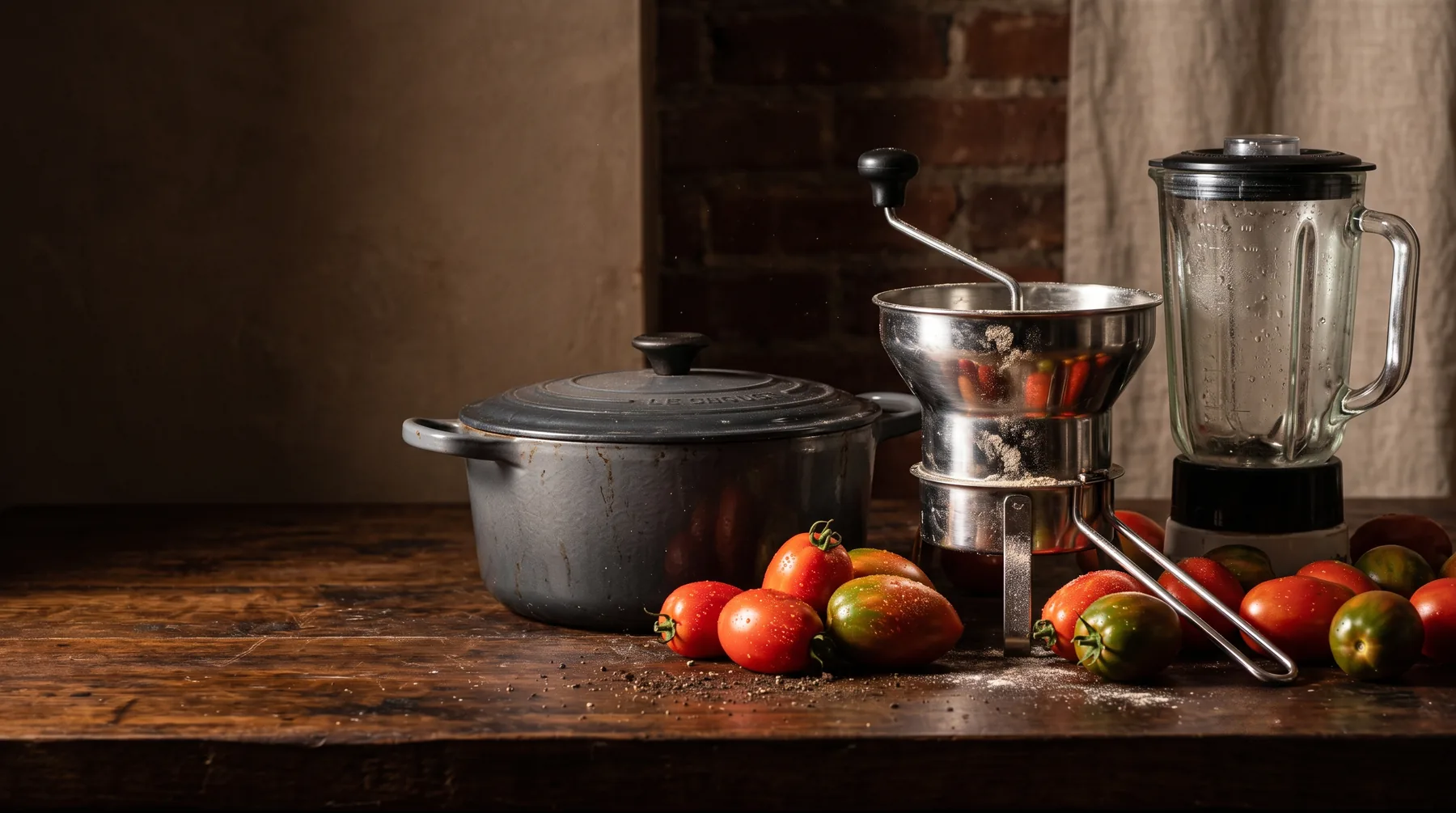
The kitchen — non-reactive pans, the right blender, and a food mill
Acid strips bare metal, blenders and mills do opposite jobs, and one of these purchases removes a full hour from every tomato sauce day.
Cook Reduction, texture, and the non-reactive pans that keep tomato tasting like tomato.
Non-reactive, always
Tomato and vinegar are acidic enough to strip bare cast iron and pull a metallic tang out of raw aluminium, and to leave a grey cast in both.
Enamelled cast iron or stainless steel. Nothing else touches an acidic sauce, ever.
Enamelled cast iron’s thermal mass holds a bare simmer for three hours without scorching, which is exactly what a tomato reduction needs. Six quarts is a full batch with headroom. For a twenty-pound day, a 12-quart stainless stockpot is the batch vessel — and it doubles as a water-bath canner for half-pints with a rack in the bottom.
A food mill is an hour of your life
This is the purchase that changes a sauce day.
Without one: blanch, ice bath, peel, seed. About an hour for twelve pounds of tomatoes. With one: halve, cook down, turn a handle. Skins and seeds stay in the hopper.
It also makes a better sauce. Tomato seeds are bitter when their coats break, and a blender pulverises both skin and seed into the sauce.
Three discs — coarse for rustic, medium for a Sunday gravy, fine for passata. All stainless, so nothing reacts. Clamp it to a real counter edge or it walks.
Blender or immersion blender
Opposite tools for opposite jobs.
High-speed blender — for hot sauce. Chile skin needs a genuinely long, high-speed blend, a full two minutes, to emulsify so the bottle does not separate. This is the one job where the expensive machine earns it.
Immersion blender — for tomato sauce and anything rustic. Blends in the pot: fewer transfers of scalding liquid, one fewer vessel to wash, and it stops at the right texture instead of going to purée. It will not fully break chile skin, so a hot sauce still needs straining.
If you buy one, buy the immersion blender. It does 80% of the work for a tenth of the price.
Straining
Fine mesh is the last pass before bottling: it catches the skin fragments and seed shards that make a sauce gritty and clog a woozy bottle’s dripper insert. It costs you 10–15% of your volume. Push it through with a ladle rather than waiting for gravity.
Smoke and dry
A pellet smoker tube turns any covered grill into a cold smoker for under twenty dollars. Burners off, tube lit, five hours of smoke. That is how a red jalapeño becomes chipotle. Ventilate for real airflow — stagnant smoke goes acrid.
A dehydrator at 125 °F dries a cayenne harvest overnight, reliably, where sun-drying loses a race with mould anywhere humid. Above about 145 °F you cook off the aromatics you spent a season growing. Stainless trays, because plastic absorbs capsaicin permanently.
A dedicated spice grinder for chile. Grind coffee in it once afterward and you will discover exactly how well capsaicin sticks to plastic.
Bottling
A hot sauce in a mason jar is a condiment you spoon. In a woozy bottle with a dripper insert it is a hot sauce, and on a 200,000 SHU sauce that drop-level control is the difference between seasoning food and ruining it.
Five ounces is the right size — you finish it while it is still good. Sterilise before filling; a woozy is not a canning jar and will not be processed.
The picks
The Hungry Artisan
Stainless Steel Food Mill, 3 discs
Paid link · commission may be earned
A blender pulverises tomato skins and seeds into the sauce, which is where bitterness comes from. A mill separates them out — no blanching, no peeling, no ice bath. It removes an entire hour from sauce day.
Why this one
- Skins and seeds stay in the hopper — no peeling step at all
- Three discs: coarse for chunky, fine for a smooth marinara
- All stainless, so nothing reacts with tomato acid
The tradeoff
- Hand-cranked. Twenty pounds of tomatoes is a genuine arm workout.
- Clamp it to a real counter edge or it walks
Lodge
Essential Enameled Cast Iron Dutch Oven, 6 qt
Paid link · commission may be earned
Tomato sauce is acidic enough to strip bare cast iron and pick up a metallic tang from aluminium. Enamel is non-reactive, and the thermal mass holds a low simmer for three hours without scorching the bottom.
Why this one
- Non-reactive enamel — mandatory for a long tomato reduction
- Cast-iron mass means an even, low simmer instead of hot spots
- 6 qt is a full batch with headroom for a hard boil
The tradeoff
- Heavy. Full, it is a two-handed lift.
- Chips if you use metal utensils or thermal-shock it
Tramontina
Gourmet Stainless 12-Quart Stock Pot
Paid link · commission may be earned
For twenty pounds of tomatoes, the Dutch oven is too small. Twelve quarts of non-reactive stainless is the batch-scale vessel, and it doubles as a water-bath canner in a pinch.
Why this one
- 12 qt handles a double batch
- Stainless is non-reactive and light enough to lift full
- Deep enough to double as a water-bath canner for half-pints with a rack
The tradeoff
- Thinner base than cast iron — scorches if you walk away from a reduction
- Not a substitute for a real canner on a full pint load
Vitamix
5200 Professional-Grade Blender, 64 oz
Paid link · commission may be earned
The difference between a hot sauce that is smooth and one that is smooth-ish is blade tip speed. A Vitamix emulsifies chile skin into the sauce so completely you do not need to strain it.
Why this one
- Genuinely emulsifies skin and pulp — no straining step, no separation in the bottle
- 64 oz handles a full batch in one go
- Repairable, with a seven-year warranty and decades of real-world service life
The tradeoff
- Five hundred dollars. The immersion blender below does 80% of this for a tenth of the price.
- Loud enough to be an event
KitchenAid
Variable Speed Hand Blender KHBV53
Paid link · commission may be earned
Blends the sauce in the pot it cooked in. No transferring boiling liquid to a jug, no splitting a batch, no second vessel to wash — and for a rustic marinara it is the *right* texture, not a compromise.
Why this one
- Blend in the pot: fewer transfers of scalding liquid, which is the real safety win
- Variable speed lets you stop at rustic instead of going to purée
- Removable arm goes in the dishwasher
The tradeoff
- Will not fully emulsify chile skin — a hot sauce still wants straining or a real blender
- Keep the guard submerged or you will repaint the ceiling
Cuisinart
Mesh Strainers, Stainless, 3-Count
Paid link · commission may be earned
The last pass before bottling. A fine mesh catches the skin fragments and seed shards that make a hot sauce gritty and clog a woozy bottle's dripper insert.
Why this one
- Three sizes cover straining, sifting and rinsing
- Stainless — non-reactive with a high-acid sauce
- Fine enough to catch what the blender missed
The tradeoff
- Straining costs you yield — expect to lose 10–15% of volume
- Push it through with a ladle, don't wait for gravity
LIZZQ
Pellet Smoker Tube, 12", Set of 2
Paid link · commission may be earned
Chipotle is nothing but a red jalapeño that has been cold-smoked for hours. A pellet tube turns any covered grill into a cold smoker for eighteen dollars.
Why this one
- Five hours of smoke per fill — enough for a full jalapeño load
- Works in any grill or even a cardboard box; no dedicated smoker needed
- Cold smoke means the chiles dry rather than cook
The tradeoff
- Needs real airflow or the smoke turns acrid and bitter
- Pellet quality decides flavour — use hardwood, not flavoured pellets
Cosori
Food Dehydrator, 6 Stainless Trays
Paid link · commission may be earned
Sun-drying chiles works in Oaxaca and fails in Ohio — humidity lets mould win the race. Controlled 125 °F airflow dries a full cayenne harvest overnight, every time.
Why this one
- Thermostatic control: 125 °F is the band that dries without cooking off the volatiles
- Stainless trays do not absorb capsaicin the way plastic does — permanently
- 6.5 ft² handles a whole plant's harvest at once
The tradeoff
- Your house will smell aggressively of chile for a full day. Run it in a garage.
- Real counter and storage footprint
BLACK+DECKER
One-Touch Coffee & Spice Grinder
Paid link · commission may be earned
Dried cayenne into powder in fifteen seconds. Dedicate one to chiles — grind coffee in it afterwards and you will find out exactly how well capsaicin sticks to plastic.
Why this one
- Fast enough that you grind fresh instead of buying stale powder
- Cheap enough to own a chile-only unit
- Stainless blade takes dried chile without stalling
The tradeoff
- Do not open the lid straight after grinding superhots — that cloud is aerosolised capsaicin
- Blade grinder, not a burr; grind is uneven by design
nicebottles
Woozy Hot Sauce Bottles, 5 oz, 24-Pack
Paid link · commission may be earned
A hot sauce in a mason jar is a condiment you spoon. In a woozy bottle with a dripper insert it is a hot sauce — and dripper control is the difference between seasoning food and ruining it.
Why this one
- Dripper inserts give you drop-level control on a 200,000 SHU sauce
- Glass, so it will not stain or hold odour like PET
- 24 is roughly two batches, which is the gifting quantity
The tradeoff
- Woozies are for finished, strained, thin sauces. A chunky salsa will clog the insert.
- Sterilise before filling — a bottle is not a canning jar and will not process
Questions people actually ask
What cookware is safe for tomato sauce and vinegar-based sauces?
Enamelled cast iron or stainless steel. Acid strips bare cast iron and pulls a metallic taste from raw aluminium, leaving a grey cast in both. A 6-quart enamelled Dutch oven is a full batch with headroom; a 12-quart stainless stockpot handles a 20-pound tomato day.
Is a food mill worth buying for tomato sauce?
Yes. Blanching, ice-bathing, peeling and seeding 12 pounds of tomatoes takes about an hour. With a food mill you halve, cook down and turn the handle, and the skins and seeds stay in the hopper. It also avoids the bitterness of seeds broken in a blender.
Blender or immersion blender for hot sauce?
A high-speed blender for hot sauce: chile skin needs a full two minutes at high speed to emulsify so the bottle does not separate. An immersion blender suits tomato sauce and anything rustic, and will not fully break chile skin, so hot sauce made with one still needs straining.
What temperature should I dry chiles in a dehydrator?
125 °F dries a cayenne harvest overnight. Above about 145 °F you cook off the aromatics. Use stainless trays, because plastic absorbs capsaicin permanently.
As an Amazon Associate I earn from qualifying purchases. Amazon is the seller on every item above; check each listing for current seller, price, and availability. Full disclosure. Reviewed 2026-09-01.