
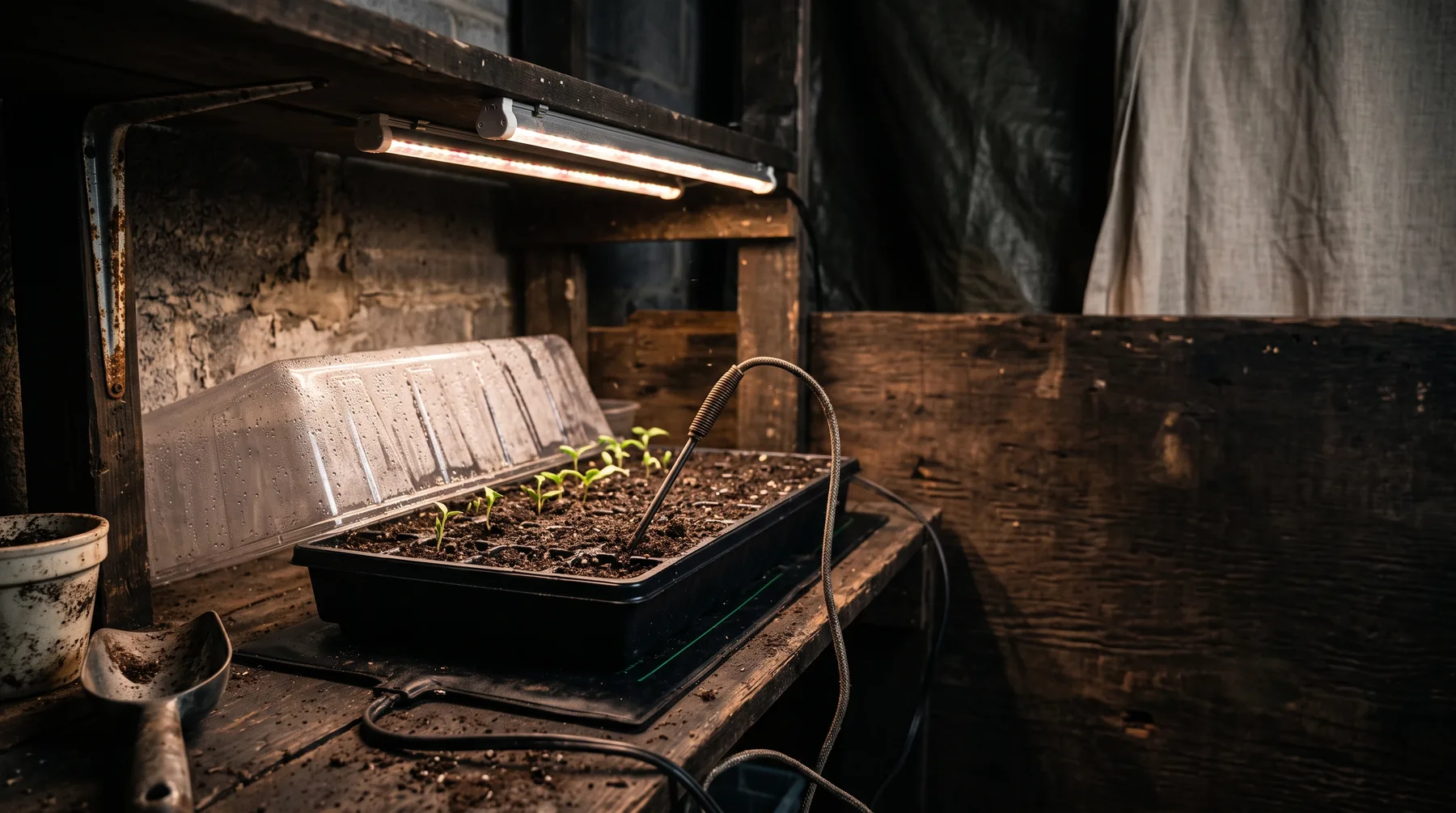
Gear · Start
Seed starting — the four things that decide the season
Heat, light, trays and mix. Get these right in February and the rest of the year is maintenance; get them wrong and there is no recovering it in May.
Start Soil temperature and light intensity, indoors, weeks before your frost date.
Seed starting is where a sauce garden is won or lost, and it comes down to four purchases. Everything else on the shelf at the garden centre is optional.
1. A heat mat with a thermostat
Not a heat mat. A heat mat with a soil probe and a controller.
Peppers germinate on soil temperature, and Capsicum chinense — habanero and up — wants 80–90 °F. At 68 °F it goes from three weeks to effectively never, and a good share of the seed rots waiting. That is the single most common reason people conclude they “can’t grow superhots.”
A bare mat with no thermostat overshoots and cooks the seed instead. The controller is the part you are actually buying.
Turn it off at emergence. Bottom heat after germination drives stretch.
2. Light, two inches away
A bright south window in March delivers a fraction of what a seedling needs, from one direction, so the plant stretches toward it and never recovers its stem thickness.
- 2–3 inches from the LED to the canopy.
- 14–16 hours a day, on a timer.
- Raise as they grow, keeping the gap.
Light intensity falls with the square of distance: moving from 3 inches to 12 cuts it by roughly sixteen times. That single number explains almost every leggy seedling.
You do not need an expensive flowering panel. This is propagation, and a 5000K LED strip is genuinely sufficient.
3. Trays that survive being lifted
Cheap black nursery trays flex enough to tear roots when you lift a full one, and they crack after a season. A heavy 1020 tray with 72-cell inserts costs more once and lasts five or more years, which is cheaper per use.
72 cells is right to true-leaf stage. Pot up from there into 3–4 inch pots — peppers and tomatoes will otherwise be root-bound weeks before your last frost, and a root-bound start never fully catches up.
Soil blocks are the alternative: air-pruned roots and no transplant shock at all, at the cost of a wetter, stickier mix and a real learning curve.
4. Seed-starting mix, not potting soil
They are different products and the difference matters.
| Seed-starting mix | Potting soil | |
|---|---|---|
| Texture | Fine | Coarse, with bark |
| Nutrients | Deliberately low | Charged |
| Purpose | Germination, first 3–4 weeks | Transplant onward |
Potting soil’s higher salt content burns new roots, and its coarse texture leaves a tiny seed with no soil contact. Seed-starting mix is low-nutrient on purpose — which is why you start feeding at true leaves, with half-strength fish emulsion weekly.
Wet the mix thoroughly and let it sit an hour before filling cells. Dry peat repels water and will float your seed out.
The supporting cast
- Humidity dome — on until emergence, off the same day. Standing humidity afterward is damping-off.
- Labels with a permanent marker — six pepper seedlings are identical for eleven weeks, and pencil and standard marker both fade.
- A small fan, a few hours a day. Suppresses damping-off and thickens stems measurably. You almost certainly already own one.
The picks
VIVOSUN
Seedling Heat Mat + Digital Thermostat
Paid link · commission may be earned
Peppers germinate on soil temperature, not air temperature. At 65 °F a habanero takes a month and half of them rot; at 85 °F it is up in eight days. The thermostat is the half that matters.
Why this one
- Thermostat with a soil probe — a bare mat runs hot and cooks seed
- Holds 80–90 °F, the actual germination band for Capsicum chinense
- 10×20.75" fits a standard 1020 tray exactly
The tradeoff
- Turn it off once seedlings emerge; bottom heat after germination makes leggy stems
- The probe must sit in the medium, not on the tray, or it reads the room
Barrina
T8 Full-Spectrum Grow Lights, 1 ft 4-pack
Paid link · commission may be earned
A south window in March delivers a fraction of the light a pepper seedling needs, and the plant tells you by stretching. Two inches of LED above the canopy for 16 hours a day fixes it permanently.
Why this one
- 5000K full spectrum is genuinely adequate for seedlings — you do not need a blurple panel
- Link end to end to cover a whole shelf on one outlet
- Runs cool enough to sit 2–3" off the canopy
The tradeoff
- Not a flowering light — this is for the propagation stage, not fruiting indoors
- 1 ft sections: buy for your actual shelf length
Bootstrap Farmer
72-Cell Trays with 1020 Bottoms, 5-Pack
Paid link · commission may be earned
The cheap black nursery trays crack after one season and flex enough to break roots when you lift them. These do not. Over five seasons the price per use is lower than the throwaways.
Why this one
- Thick, genuinely reusable plastic — the standard against which cheap trays are measured
- 72 cells is the right density for peppers and tomatoes to true-leaf stage
- 1020 footprint fits every heat mat, dome and light on this site
The tradeoff
- Real money up front against $8 flimsy trays
- 72 small cells means you must pot up before transplant; peppers outgrow them
Clone Dome
7" Vented Humidity Domes, 5-Pack
Paid link · commission may be earned
A dome is the difference between checking moisture twice a day and checking it twice a week. The 7-inch height matters: a 2-inch dome is useless the moment a pepper puts up true leaves.
Why this one
- 7" clears seedlings for weeks before you have to remove it
- Adjustable vents let you wean humidity down instead of shocking the tray
- Fits standard 1020 trays
The tradeoff
- Come off the moment the first true leaves appear or you invite damping-off
- Five-pack is more than a home grower needs in one season
Espoma
Organic Seed Starter Potting Mix
Paid link · commission may be earned
Seed-starting mix is not potting soil with a nicer label — it is finer, lighter, and low in nutrients on purpose, because a seedling's first roots want air and moisture, not fertiliser.
Why this one
- Fine texture holds contact with a small seed without crusting
- Low nutrient load — high-salt potting soil burns new roots
- Sphagnum/perlite base drains fast enough to keep damping-off down
The tradeoff
- Because it is low-nutrient, seedlings need feeding from true-leaf stage onward
- Wet it thoroughly and let it sit an hour before filling cells; dry peat repels water
KHAMAL
2-Inch Soil Blocker, 4-Cell
Paid link · commission may be earned
Soil blocks air-prune roots instead of spiralling them around a cell wall, so a blocked seedling transplants without the check that costs a potted one a week of growth.
Why this one
- No transplant shock — the block goes into the ground whole
- Air-pruned roots branch instead of circling
- No plastic cells to store, wash or replace
The tradeoff
- Needs a wetter, stickier block mix than standard seed-starting mix
- A real technique with a learning curve; your first tray of blocks will crumble
Fish Emulsion
Fish Emulsion Liquid Fertilizer
Paid link · commission may be earned
Seed-starting mix runs out of nitrogen about two weeks after true leaves. Half-strength fish emulsion weekly from that point is the whole feeding programme until transplant.
Why this one
- Gentle, low-salt nitrogen that will not burn young roots
- Fast-acting where a granular feed is too slow for a 6-week window
- Cheap per application at half strength
The tradeoff
- It smells exactly like what it is. Feed in a garage or outdoors.
- Do not feed before true leaves — the seed carries everything until then
Xgunion
T-Type Plant Labels, 200 pcs + Marker
Paid link · commission may be earned
Six pepper seedlings look identical for eleven weeks. Ask anyone who has planted a habanero where the Marconi should have gone.
Why this one
- Included marker is genuinely permanent — pencil and Sharpie both fade by July
- T-shape stays legible above the canopy
- 200 covers several seasons
The tradeoff
- UV eventually takes the ink; re-label anything you're carrying into a second year
As an Amazon Associate I earn from qualifying purchases. Amazon is the seller on every item above; check each listing for current seller, price, and availability. Full disclosure. Reviewed 2026-09-01.