
Gear · Grow
Containers, soil and support — where container gardens actually fail
Root volume, watering consistency and something strong enough to hold a loaded indeterminate tomato in August. Three problems, three purchases.
Grow Root volume, nutrition and structure. Where most home crops actually fail.
Almost every container failure is one of three things: not enough root volume, watering by memory, or support that collapses in July.
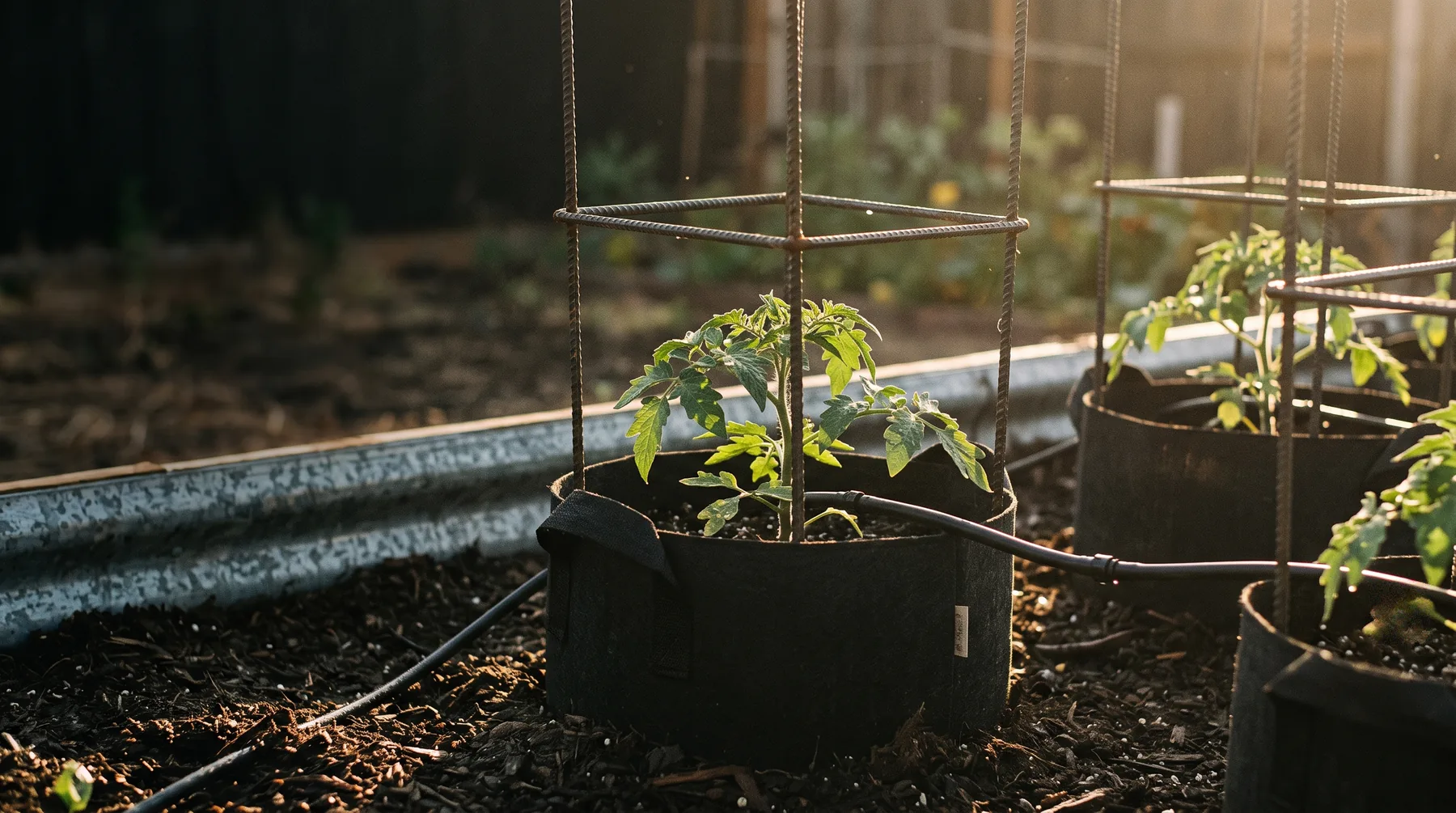
Fabric pots beat plastic, and here is why
A plastic pot spirals roots around the inside wall until the plant is bound. A fabric pot air-prunes: the root tip hits air at the fabric, dies back, and the plant branches behind it. You end up with a dense fibrous root ball rather than a spiral.
Fabric also drains hard, which makes waterlogging nearly impossible — and means it dries out fast. In July a 5-gallon bag can want water daily.
Working minimums: 5 gallons per pepper, 10 per tomato or tomatillo. Undersized pots do not give you smaller plants; they give you plants that dry twice a day, run out of food in July and drop fruit.
Raised beds: the volume nobody budgets for
A 4×8×1 ft bed is 32 cubic feet — about 21 bags of potting mix, several hundred dollars if you fill it with bagged mix alone.
The normal approach is to blend: bulk topsoil and compost for the lower two-thirds, quality mix in the top third where the roots actually are. Galvanized steel beds go together in an afternoon and outlast cedar by a decade.
Potting mix, not garden soil
Garden soil compacts in a container. In open ground, worms, roots and freeze-thaw maintain structure; in a pot none of that happens and it becomes a dense block that holds water and excludes air.
Use a quality aerated potting mix. A pre-charged mix carries a transplant for its first month with no feeding, which covers exactly the window when most container plants stall.
Support, installed at transplant
The conical wire tomato ring sold everywhere is 33 inches tall. An indeterminate San Marzano goes to 6–8 feet and will flatten it in July.
- 58-inch square cages — real height, and square frames don’t tip under load.
- Florida weave with trellis netting — cheaper per plant for a row and gives better airflow, which directly reduces fungal pressure.
Install at transplant. Caging a grown plant means breaking it.
Watering: the purchase that prevents three problems
Blossom end rot, split fruit and flower drop all trace to the same cause — moisture that swings. A fifty-dollar drip kit with a tap timer removes the human from the loop.
That is the actual fix. Foliar calcium treats the symptom of BER; consistent water treats the cause. See container soil and feeding for the full mechanism.
Feeding: low nitrogen
The most common feeding mistake is a general-purpose high-N fertiliser on a fruiting crop. Nitrogen builds leaves — you get a magnificent plant with four tomatoes on it.
Want low N, higher K: something like 3-4-6 with calcium, monthly from first flower. Worm castings in the planting hole are a cheap, unglamorous improvement you can see by August.
Testing
In-ground growers should test. pH outside 6.0–6.8 locks nutrients out chemically no matter how much you feed. Container growers can skip it — bagged mix is already in range.
A moisture meter is worth having for one thing only: reading moisture at root depth rather than at the dry top inch you can see. Ignore the pH scale printed on it.
The picks
VIVOSUN
5-Gallon Fabric Grow Bags, 5-Pack
Paid link · commission may be earned
Fabric pots air-prune roots and drain faster than a plastic pot can, which is the entire reason container tomatoes fail. Five gallons is the honest minimum for a pepper; a tomato wants ten.
Why this one
- Air pruning gives a dense fibrous root ball instead of a spiral
- Drains hard — near-impossible to waterlog
- Fold flat for winter storage
The tradeoff
- Dry out much faster than plastic — in July a 5-gallon bag can need daily water
- 5 gal is right for peppers, tight for an indeterminate tomato
Meberam
8×4×1 ft Galvanized Raised Beds, 2-Pack
Paid link · commission may be earned
A 4×8 bed holds twelve to sixteen sauce plants with real root volume, and a metal bed goes together in an afternoon and outlasts cedar by a decade.
Why this one
- 32 cubic feet of root volume per bed — enough that watering swings stop mattering
- Galvanized steel does not rot, warp or need sealing
- Modular: two beds is the whole sauce garden
The tradeoff
- Filling it is the real cost — 32 ft³ is around 21 bags of mix per bed
- Metal beds heat up in full sun; mulch the surface
FoxFarm
Ocean Forest Potting Soil
Paid link · commission may be earned
Pre-charged with enough nutrition to carry a transplant for its first month without feeding, which is exactly the window when most container plants stall.
Why this one
- Aerated, fast-draining base — will not compact into a brick by August
- Comes charged: no feeding needed for the first 30 days
- Consistent bag to bag, which cheap mixes are not
The tradeoff
- Rich enough to burn seedlings — this is a transplant mix, not a seed-starting mix
- 1.5 ft³ per bag; a 5-gallon bag of soil takes about half of one
Wiggle Worm
Pure Organic Worm Castings, 15 lb
Paid link · commission may be earned
Not a fertiliser so much as a soil-biology inoculant with a mild nutrient charge. A cup in each planting hole is a cheap, unglamorous improvement you can measure by August.
Why this one
- Gentle enough to touch roots directly — you cannot burn a plant with it
- Improves water retention and structure in both containers and beds
- 15 lb does about 20 planting holes
The tradeoff
- Not a substitute for real feeding through fruit set
- Sold in wildly varying quality; this is the reference product
Espoma
Organic Tomato-Tone 3-4-6 with 8% Calcium
Paid link · commission may be earned
The NPK ratio is the point: low nitrogen, higher potassium. Feed a tomato a high-nitrogen lawn fertiliser and you get a magnificent six-foot plant with four tomatoes on it.
Why this one
- 3-4-6 pushes fruit rather than foliage
- 8% calcium directly addresses the blossom-end-rot pathway
- Slow release — feed monthly, not weekly
The tradeoff
- Granular and slow; it will not rescue a plant that is already deficient
- Works on peppers too, at about two-thirds the tomato rate
Bonide
Rot-Stop Blossom End Rot Concentrate
Paid link · commission may be earned
Blossom end rot is almost never a soil calcium shortage — it is a calcium *transport* failure caused by inconsistent water. A foliar calcium spray buys time while you fix the watering, which is the real cure.
Why this one
- Foliar calcium bypasses the uptake problem for fruit already setting
- Cheap insurance in containers, where water swings are unavoidable
- Works on peppers and tomatoes both
The tradeoff
- Treats the symptom. Consistent moisture and mulch treat the cause.
- Fruit already showing the black lesion will not recover; it protects the next set.
K-Brands
58" Square Tomato Cages, 3-Pack
Paid link · commission may be earned
The conical wire tomato ring from the hardware store is 33 inches tall and an indeterminate San Marzano will laugh at it in July. Height and square geometry are what actually hold a loaded plant.
Why this one
- 58" is real height for an indeterminate paste tomato
- Square frames do not tip the way cones do under fruit load
- Fold flat for winter
The tradeoff
- Still not enough for a plant that wants to hit 8 ft — top it or add a stake
- Set them at transplant; caging a grown plant means breaking it
VIVOSUN
Plant Trellis Netting, 5 × 30 ft
Paid link · commission may be earned
The Florida weave with netting is the cheapest way to support a whole row of paste tomatoes. Two posts and a net beat sixteen individual cages on cost and on airflow.
Why this one
- Supports a full row for the price of two cages
- Open mesh keeps airflow through the canopy — direct fungal-pressure reduction
- Reusable across seasons
The tradeoff
- Needs posts at each end; the net supports nothing on its own
- Tangles badly at end of season — cut it out rather than unpicking it
Thiswing
Drip Irrigation System with Timer, 16 Nozzles
Paid link · commission may be earned
Blossom end rot, split tomatoes and bitter fruit all trace back to the same thing: water that swings. A $50 timer removes the human from the loop and removes the swing.
Why this one
- Timer on the tap is the actual fix — consistency beats volume
- Drip at the root zone keeps foliage dry, which cuts fungal pressure hard
- Covers a bed or a row of containers
The tradeoff
- Emitters clog on hard water; flush the line each spring
- Newer listing with a modest review count
Luster Leaf
Rapitest Soil Test Kit
Paid link · commission may be earned
In-ground growers are guessing until they test. pH outside 6.0–6.8 locks nutrients out no matter how much fertiliser you add, and no amount of feeding fixes that.
Why this one
- pH plus N-P-K in one kit, 40 tests
- Enough precision to tell you whether to lime or not, which is the decision that matters
- Cheap relative to a lab test
The tradeoff
- Colour-comparison chemistry — good to about half a pH point, not a lab result
- Container growers can skip this entirely; bagged mix is already in range
SONKIR
3-in-1 Soil Moisture / Light / pH Tester
Paid link · commission may be earned
Used for one thing — is the root zone actually dry six inches down — it prevents both halves of the most common container failure. Ignore the pH scale on it entirely.
Why this one
- Reads at root depth instead of the dry top inch you can see
- No batteries
- Instant answer to the only watering question that matters
The tradeoff
- The pH function on these is not accurate. Use the real test kit or a meter for pH.
- The light meter is decorative
As an Amazon Associate I earn from qualifying purchases. Amazon is the seller on every item above; check each listing for current seller, price, and availability. Full disclosure. Reviewed 2026-09-01.