Gear · Harvest
Harvest — cutting, carrying, weighing, and not burning your hands
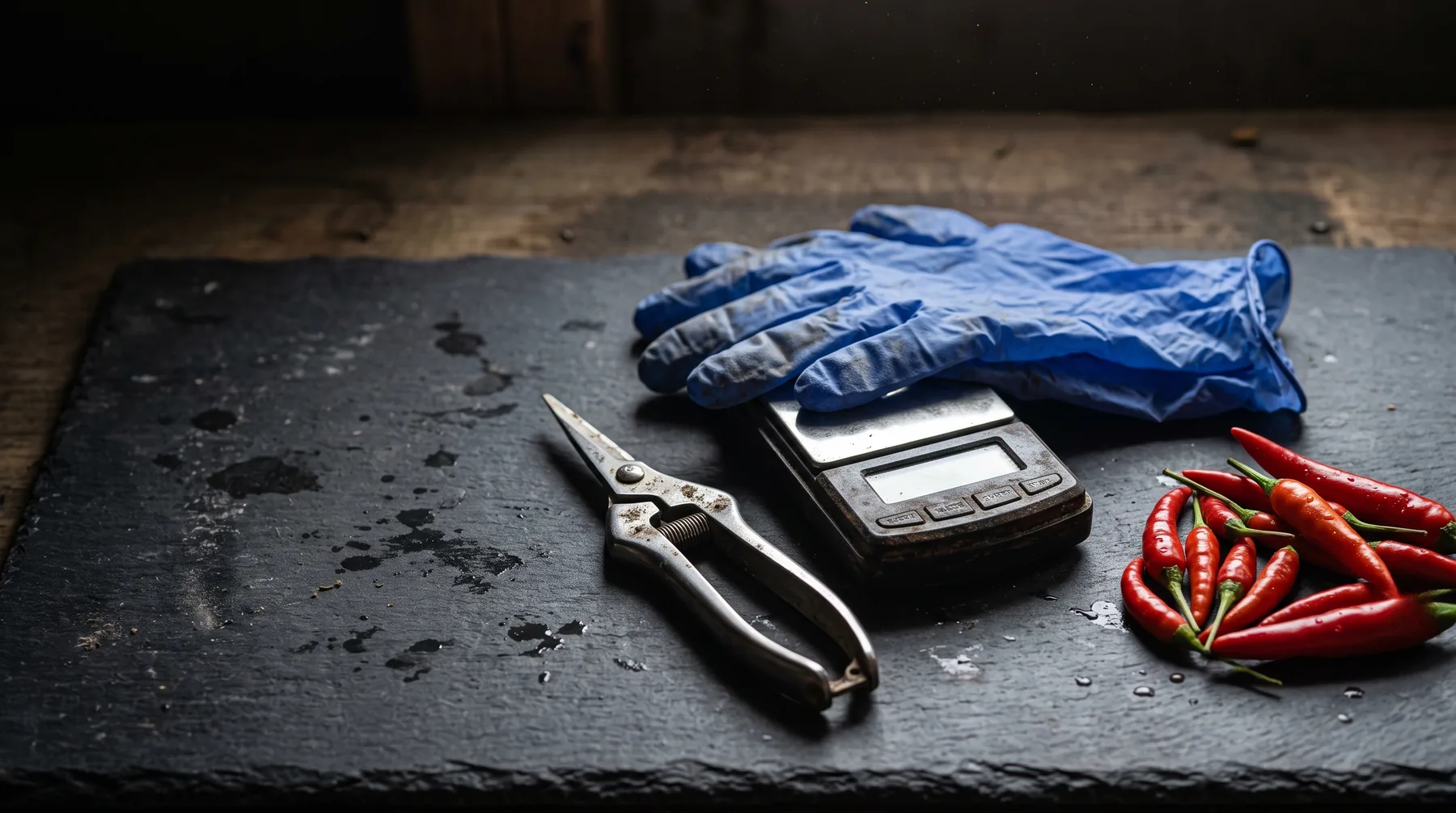
Five cheap things. One of them is not optional if you are ever going to touch a habanero, and one of them is the reason your fermentation is safe.
Harvest Timing, handling, and weighing what you actually got.
The cheapest phase in the pipeline, and it contains two purchases you genuinely cannot skip.
Nitrile gloves — the non-negotiable one
Capsaicin is oil-soluble. It does not wash off with soap, it stays on your hands for hours, and it will transfer to your eyes long after you have forgotten about it.
Seeding a pound of habaneros bare-handed is a mistake people make exactly once. Nitrile, not latex or vinyl — nitrile is the one that actually blocks capsaicin oil.
Change them if you tear one, and ventilate the kitchen when you blend superhots: you are aerosolising capsaicin, and it finds your eyes and throat.
A gram scale — the safety one
This is not a convenience item, it is the tool that makes a fermentation safe.
Brine strength is a percentage of total weight, not a number of spoons. A cup of kosher salt and a cup of table salt are not the same amount of salt — crystal size differs by up to a factor of two. Without a gram scale you are not following a fermentation recipe, you are guessing at the one number that determines the outcome.
You want 1 g resolution and a tare function. See fermentation salt and safety for the arithmetic.
Snips, not fingers
Pulling a pepper tears the branch and opens a wound that invites disease. Ninety percent of sauce-garden cutting is a pepper stem or a basil node, and fine micro-tip snips do that better than any pruner.
Keep a pair in the kitchen too. Harvesting basil is pinching basil — the maintenance and the harvest are the same action.
Bypass pruners are the second tool, for anything genuinely woody, and a rebuildable Swiss pair is a lifetime purchase where the snips are a three-season consumable.
A basket that drains
A harvest basket that doubles as a colander means the rinse happens in the garden and the soil stays outside. On a twenty-pound tomato day that is a real time saving, and rigid sides do not bruise fruit the way a bag does.
A cheap plastic colander does most of this job. Buy the nice one if you are harvesting often enough to notice.
Two rules
Cut, don’t pull. Every time.
Pick in the morning. Turgor is highest and field heat lowest, and it genuinely affects how long a harvest holds before you get to process it.
The picks
Fiskars
6" Micro-Tip Pruning Snips
Paid link · commission may be earned
Ninety percent of sauce-garden cutting is snipping a pepper stem or a basil node, and a fine-tipped snip does it better than any pruner. Pulling peppers by hand tears the branch.
Why this one
- Fine tips reach into a canopy without damaging what's around the cut
- Correct tool for basil pinching, which you do weekly all season
- Cheap enough to keep one in the kitchen and one in the garden
The tradeoff
- Not for anything woody — the tips will spring
- Not rebuildable; a consumable over about three seasons
FELCO
F5 Pruning Shears
Paid link · commission may be earned
Swiss-made, fully rebuildable, and sharpenable forever. The blade and the spring are both replaceable parts, which is why gardeners hand these down instead of replacing them.
Why this one
- Every wearing part is a replaceable spare — a lifetime tool in the literal sense
- Clean bypass cut that does not crush stems and invite disease
- Hardened steel blade that takes and holds an actual edge
The tradeoff
- This is the F5, not the smaller F2 — a larger hand size
- Real money for a pruner. The Fiskars snips below cover most sauce-garden work for a tenth of it.
Fiskars
Garden Harvest Basket with Tool Caddy
Paid link · commission may be earned
A harvest basket that doubles as a colander means the hose rinse happens in the garden, and the dirt stays outside. On a 20-pound tomato day that is a genuine time saving.
Why this one
- Perforated — rinse and drain in one vessel
- Rigid sides do not bruise fruit the way a bag does
- Tool caddy keeps the snips with you
The tradeoff
- Pricey for a basket. A cheap plastic colander does 80% of the job.
Etekcity
Digital Kitchen Scale, 11 lb, g/oz
Paid link · commission may be earned
Fermentation brine is a percentage of weight, not a number of spoons. Without a gram scale you are not following a fermentation recipe — you are guessing at the one number that determines whether it is safe.
Why this one
- 1 g resolution, which is what a 2.5% brine calculation actually needs
- Tare function for weighing into a vessel
- 11 lb capacity covers a full sauce batch
The tradeoff
- 11 lb ceiling — a 20-pound tomato haul needs two weighings
- Battery-powered; keep spares
FINITEX
Nitrile Exam Gloves, 200 pcs, food-safe
Paid link · commission may be earned
Capsaicin is oil-soluble and does not wash off with soap. Seeding a pound of habaneros bare-handed means eight hours of burning hands and one unforgettable mistake involving your own eye.
Why this one
- Nitrile blocks capsaicin oil where latex and vinyl leak
- Food-safe rated
- 200 per box — you will use them
The tradeoff
- Change them if you tear one; capsaicin finds the hole
- Ventilate the kitchen too — blitzing superhots aerosolises capsaicin
As an Amazon Associate I earn from qualifying purchases. Amazon is the seller on every item above; check each listing for current seller, price, and availability. Full disclosure. Reviewed 2026-09-01.