
Guide · fermenting
Fermentation: brine percentage, and what actually goes wrong
Salt is a percentage of weight, not a number of spoons. How to calculate it, why anaerobic matters more than sterile, and how to tell kahm yeast from mould without guessing.
Lacto-fermentation is not a mysterious craft. It is a controlled competition, and you set the rules.
Three conditions do all the work:
- Salt at a concentration lactobacillus tolerates and most spoilage organisms do not.
- No oxygen, which excludes moulds and aerobic bacteria entirely.
- Falling pH, which the lactobacillus itself creates and which then locks out everything else.
Get all three right and it is very difficult to fail. Get the second one wrong and you get mould.
Salt is a percentage
This is the number people get wrong, because recipes are written in tablespoons and tablespoons are meaningless.
Brine % = (weight of salt ÷ total weight of vegetables + water) × 100
Both weights, on a gram scale. A worked example for a hot sauce batch:
| Chiles, carrot, onion, garlic | 2268 g (5 lb) |
| Water | 1134 g (40 oz) |
| Total | 3402 g |
| Target brine | 3% |
| Salt needed | 3402 × 0.03 = 102 g |
Picking a percentage
| Brine | Behaviour | Use for |
|---|---|---|
| 2% | Fast, softer texture, less margin for error | Quick ferments in cool rooms |
| 2.5–3.5% | The reliable working band | Hot sauce, most vegetables |
| 5%+ | Very slow, firm texture, high margin | Long ferments, warm climates, olives |
Below about 2% you lose your safety margin. Above about 5% the lactobacillus itself is inhibited and the ferment stalls.
Use canning and pickling salt. Iodine suppresses the organism you are cultivating; anti-caking agents cloud the brine. And always weigh — kosher, sea and table salt differ by up to a factor of two by volume.
Anaerobic beats sterile
Almost every failed ferment is a floating-solids problem.
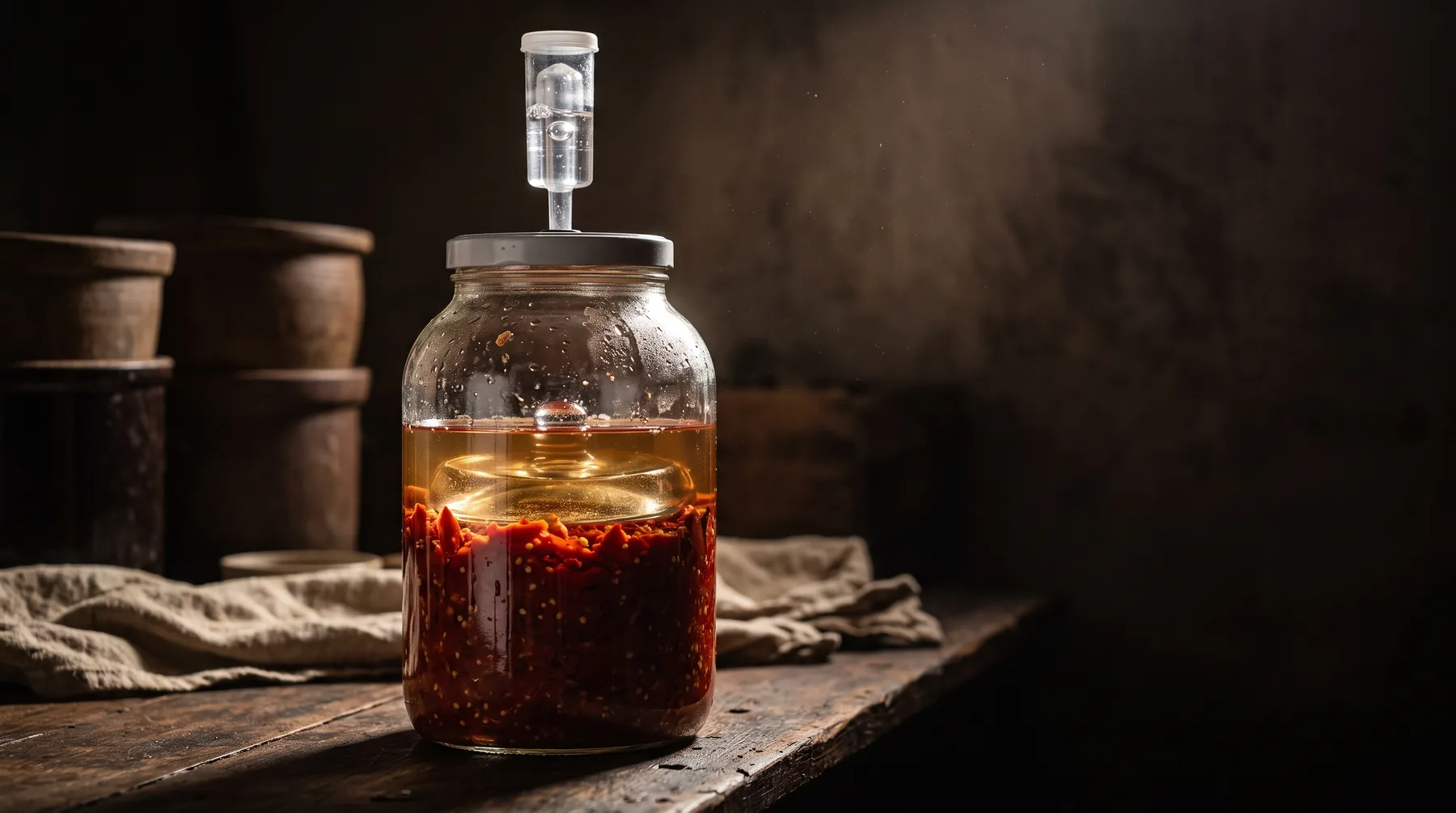
Moulds are aerobic: they need air. Anything that floats above the brine line is in air, and it will grow mould, and that mould will then colonise downward. A glass fermentation weight solves this permanently and costs about fifteen dollars.
- Everything under the brine. Everything.
- Airlock lid so CO₂ escapes without oxygen entering.
- Do not open the jar to check on it. Opening it is the risk.
Reading a ferment
Days 1–2. Little visible. Brine may cloud slightly. Days 3–7. Vigorous bubbling. Brine goes cloudy and pale — this is the lactobacillus bloom and it is what you want. Smell is sharp and sour. Days 7–21. Bubbling slows and stops. pH keeps dropping. Colour dulls slightly. Days 21–28. Sour, complex, and stable. Ready.
Bubbling stopping is not death. It means the vigorous CO₂ phase finished. Judge by pH.
Kahm yeast versus mould
This is the one identification you must be able to make.
| Kahm yeast | Mould | |
|---|---|---|
| Appearance | Flat, thin, white or cream, often wrinkled | Raised, fuzzy, three-dimensional |
| Colour | White/cream only | Blue, green, black, pink, grey |
| Smell | Yeasty, slightly off | Musty, earthy, obviously wrong |
| Verdict | Skim it, submerge, continue | Discard the whole batch |
Do not scrape mould off and use what’s beneath it. Mould hyphae extend well below the visible surface, and some species produce mycotoxins that are not confined to the fuzzy part.
Where the pH lands, and what that does and doesn’t mean
A successful vegetable ferment lands at pH 3.0–3.5, far below the 4.6 line, and that is why fermented hot sauce keeps for over a year in the refrigerator.
It is not, on its own, a licence to shelf-store. Shelf stability needs a tested process — a validated combination of ratio, acid addition, jar size and process time — and a recipe you wrote is not one. Ferment it, verify the pH, bottle it, refrigerate it. See the acid math for why the distinction is real.
Handling chiles
Capsaicin is oil-soluble. It does not wash off with soap and it stays on your hands for hours.
- Nitrile gloves, both hands, from the first chile.
- Ventilate when blending superhots — you are aerosolising capsaicin, and it will find your eyes and your throat.
- Let the blender settle for a minute before opening the lid.
Related crops
Related sauces
Sources
Every food-safety number on this page traces to one of these. If you are going to trust one link on this site, trust these over us.
The gear this guide assumes
Digital Kitchen Scale, 11 lb, g/ozMust have
Fermentation brine is a percentage of weight, not a number of spoons. Without a gram scale you are not following a fermentation recipe — you are guessing at the one number that determines whether it is safe.
Nitrile Exam Gloves, 200 pcs, food-safeMust have
Capsaicin is oil-soluble and does not wash off with soap. Seeding a pound of habaneros bare-handed means eight hours of burning hands and one unforgettable mistake involving your own eye.
Canning & Pickling Salt, 4 lb ×4Must have
Table salt carries iodine and anti-caking agents. Iodine suppresses the lactobacillus you are trying to cultivate and the anti-caking agent turns your brine cloudy grey.
Complete Mason Jar Fermentation KitMust have
Fermentation is anaerobic. An airlock lets CO₂ out without letting oxygen in, which is the entire difference between a clean lacto-ferment and a jar of kahm yeast and mould.
Glass Fermentation Weights, 4-PackMust have
Anything floating above the brine will mould. A glass weight holds the chile mash under the surface for three weeks without you touching it, which is the whole job.
1-Gallon Fermenting Jar with Twin-Bubble Airlock
Ten pounds of habaneros does not fit in a quart jar. A gallon vessel is what a real hot-sauce batch needs, and glass lets you watch the ferment instead of guessing.
AI311 PH60 Waterproof Pocket pH TesterMust have
The 4.6 line is not a guideline, it is the number below which Clostridium botulinum cannot grow. Strips get you to half a pH point. This gets you to ±0.1, and for anything you intend to keep, that difference is the whole ballgame.
AI1113 pH Calibration Buffer Kit (4.00 / 7.00)
A pH meter is only as honest as its last calibration. Two-point calibration at 4.00 and 7.00 brackets the entire range a sauce ever lives in.
Hydrion Short-Range pH Strips, 0.0–6.0
The budget answer, and a genuinely usable one: a 0–6 range in 0.5 steps tells you whether a ferment has crossed 4.6. Universal 1–14 strips cannot — they are useless for this job.
Paid links. We earn a commission from Amazon if you buy; you pay the same. Disclosure.
Questions people actually ask
Do I have to sterilise everything?
No, and trying to is counterproductive. Lacto-fermentation works because you create conditions the organisms you want tolerate and the ones you don't cannot — salt, no oxygen, and falling pH. Clean equipment with hot soapy water. Sterilising is for canning, where you are trying to have nothing alive; fermenting is the opposite.
Can I use kosher or sea salt?
Yes, as long as it is pure sodium chloride with no iodine and no anti-caking agent. Iodine suppresses lactobacillus and anti-caking agents cloud the brine. Because crystal size differs enormously between salts, always weigh — a cup of kosher salt and a cup of table salt are not the same amount of salt.
How do I know when it's done?
pH and taste, never bubbles. Vigorous CO₂ lasts 3–7 days and then slows while the pH keeps falling. A hot sauce ferment is generally ready at 21–28 days at pH 3.2–3.5. Longer means more sour and more complex.
White film on top — ruin or not?
Almost always kahm yeast: a flat, wrinkly, white film that forms where brine meets air. Harmless. Skim it and get everything back under the brine. Fuzzy, raised, coloured growth — blue, green, black, pink — is mould, and that batch goes in the bin. Do not scrape mould off and use what's underneath; hyphae penetrate well below what you can see.
Last reviewed 2026-09-01 by the SeedsToSauce Test Kitchen.Corrections welcome.