
Kit · Containers
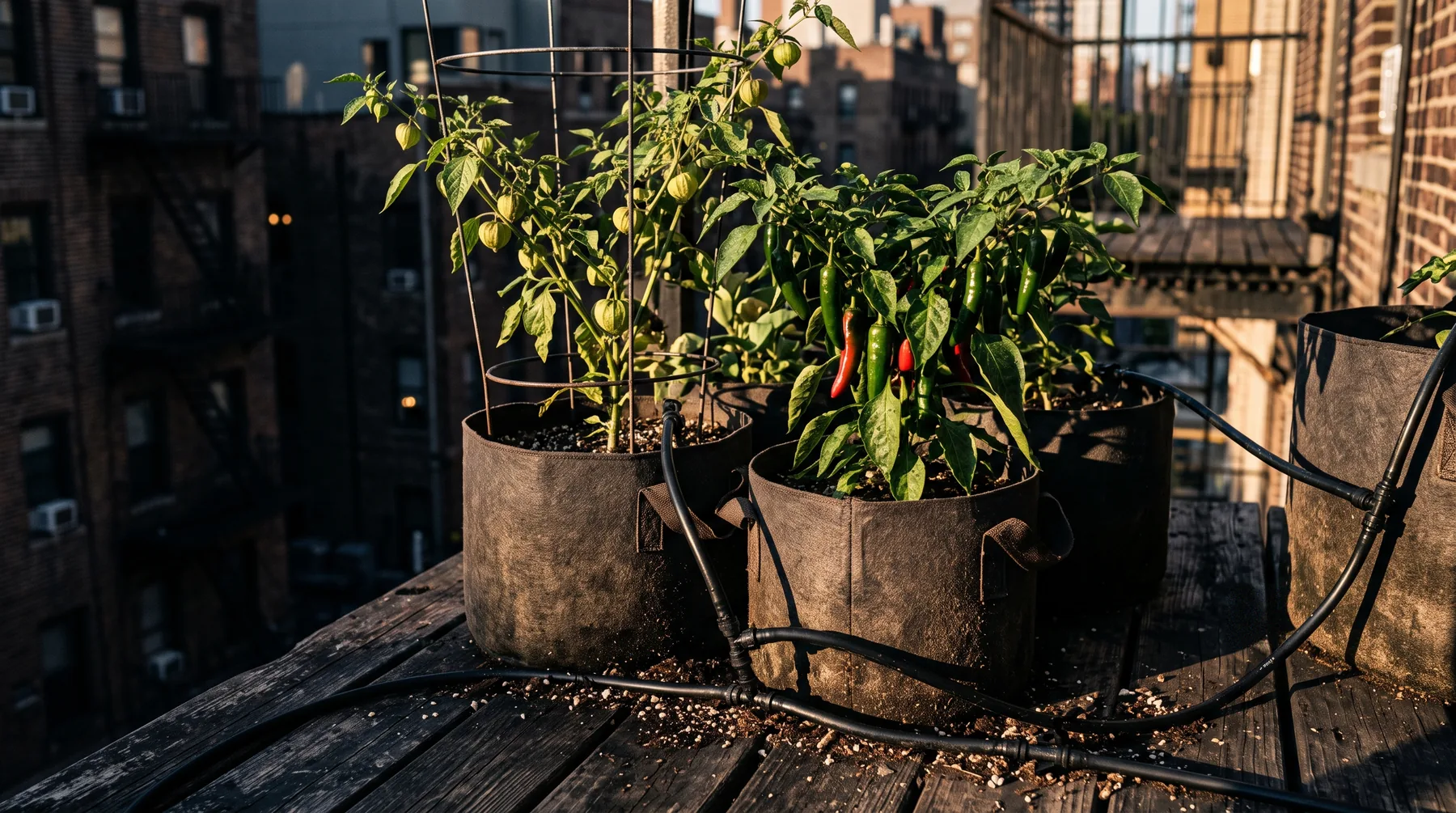
The Balcony Salsa Garden
Six to eight containers on a sunny deck, and enough tomatillo, serrano and cilantro for a real batch of salsa verde plus a summer of fresh eating.
20 pieces · bought separately, chosen to work together
A deck or balcony with six or more hours of direct sun, six to eight fabric pots, and a drip line on a tap timer.
This is the setup that produces a real batch of salsa verde — four pounds of tomatillos — rather than a garnish.
Why we bundled it this way
Two tomatillo plants minimum, and that is not negotiable. Tomatillos are self-incompatible: a single plant cannot pollinate itself and will set a scattering of empty husks. This single fact ruins more tomatillo seasons than every pest combined, so the kit is scoped around at least two 10-gallon bags for them.
The drip kit is in here on purpose. A 10-gallon fabric bag in July can need water daily, and moisture swings are what cause blossom end rot, split fruit and flower drop. On a balcony, where nobody is home at 2pm, a tap timer is the actual solution. It is the most boring item in the kit and the one that saves the season.
Cilantro is a succession crop, not a plant. One sowing gives you three or four weeks of leaf and then bolts, whatever the packet says. Sow a short row every two weeks in the smallest pots. The packet holds a thousand seeds; this costs nothing.
The immersion blender is here rather than a high-speed blender because salsa verde should be coarse, not puréed — and blending in the pot means not moving hot liquid around a small kitchen.
What it produces
About four pints of salsa verde, plus fresh salsa and zhoug all summer, from roughly six to eight plants.
The timeline
Sow six weeks before last frost, transplant after it, first tomatillos about 70 days later, salsa day two weeks after that. Plan Builder for your zone’s dates.
What this kit makes
What's in the kit
This is a curated set, not an Amazon bundle — each piece is its own listing, so you can skip anything you already own. They're listed in the order you'll use them.
Amazon supports up to 10 items per add-to-cart link; add each group to the same cart. Amazon opens your cart for review.
Sow Right Seeds
Toma Verde Tomatillo Seed
Paid link · commission may be earned
Salsa verde is not a green tomato sauce — it is a tomatillo sauce, and the difference is the tartness and the natural pectin that makes it cling. There is no substitute.
Why this one
- 60–70 days, one of the fastest fruit crops on this site
- Naturally acidic (pH ~3.8 raw), which does real work in a preserved sauce
- Enormously productive — 60+ fruit per plant is normal
The tradeoff
- Tomatillos are self-incompatible: ONE plant sets almost nothing. You must grow at least two.
Sow Right Seeds
Serrano Pepper Seed
Paid link · commission may be earned
Cleaner and greener than a jalapeño at roughly three times the heat. The correct chile for salsa verde and zhoug, where you want brightness rather than smoke.
Why this one
- 10,000–23,000 SHU — hot enough to carry a green sauce without a superhot's fruit
- Thin walls mean it blends smooth without peeling
- Extremely productive: one plant carries 40+ pods
The tradeoff
- Thin walls also mean it does not dry or freeze as well as thicker chiles
Sow Right Seeds
Cilantro / Coriander Seed
Paid link · commission may be earned
Bolts in a heartbeat and there is nothing you can do about it — so you succession-sow instead of fighting it. Non-negotiable in salsa verde and zhoug.
Why this one
- Direct-sown, 45 days to usable leaf
- Cheap enough per packet to sow every two weeks all season
- Bolted plants give you coriander seed, which is a second ingredient, not a failure
The tradeoff
- Transplants poorly — it has a taproot. Sow where it will grow.
- Will bolt in 3 weeks above 75 °F no matter what the packet says
Sow Right Seeds
Yellow Sweet Spanish Onion Seed
Paid link · commission may be earned
A long-day storage onion with enough sugar to sweat down without scorching. The aromatic base under every tomato sauce on this site.
Why this one
- Grown from seed, not sets — better storage life and no bolting from a stressed set
- 110 days, so it goes in earlier than anything else here
- Sweet enough to caramelize rather than just soften
The tradeoff
- Long-day: correct above roughly 36° N latitude, wrong in the deep South
- Needs a 10–12 week indoor head start, the earliest sow on the whole calendar
Espoma
Organic Seed Starter Potting Mix
Paid link · commission may be earned
Seed-starting mix is not potting soil with a nicer label — it is finer, lighter, and low in nutrients on purpose, because a seedling's first roots want air and moisture, not fertiliser.
Why this one
- Fine texture holds contact with a small seed without crusting
- Low nutrient load — high-salt potting soil burns new roots
- Sphagnum/perlite base drains fast enough to keep damping-off down
The tradeoff
- Because it is low-nutrient, seedlings need feeding from true-leaf stage onward
- Wet it thoroughly and let it sit an hour before filling cells; dry peat repels water
VIVOSUN
Seedling Heat Mat + Digital Thermostat
Paid link · commission may be earned
Peppers germinate on soil temperature, not air temperature. At 65 °F a habanero takes a month and half of them rot; at 85 °F it is up in eight days. The thermostat is the half that matters.
Why this one
- Thermostat with a soil probe — a bare mat runs hot and cooks seed
- Holds 80–90 °F, the actual germination band for Capsicum chinense
- 10×20.75" fits a standard 1020 tray exactly
The tradeoff
- Turn it off once seedlings emerge; bottom heat after germination makes leggy stems
- The probe must sit in the medium, not on the tray, or it reads the room
Barrina
T8 Full-Spectrum Grow Lights, 1 ft 4-pack
Paid link · commission may be earned
A south window in March delivers a fraction of the light a pepper seedling needs, and the plant tells you by stretching. Two inches of LED above the canopy for 16 hours a day fixes it permanently.
Why this one
- 5000K full spectrum is genuinely adequate for seedlings — you do not need a blurple panel
- Link end to end to cover a whole shelf on one outlet
- Runs cool enough to sit 2–3" off the canopy
The tradeoff
- Not a flowering light — this is for the propagation stage, not fruiting indoors
- 1 ft sections: buy for your actual shelf length
Bootstrap Farmer
72-Cell Trays with 1020 Bottoms, 5-Pack
Paid link · commission may be earned
The cheap black nursery trays crack after one season and flex enough to break roots when you lift them. These do not. Over five seasons the price per use is lower than the throwaways.
Why this one
- Thick, genuinely reusable plastic — the standard against which cheap trays are measured
- 72 cells is the right density for peppers and tomatoes to true-leaf stage
- 1020 footprint fits every heat mat, dome and light on this site
The tradeoff
- Real money up front against $8 flimsy trays
- 72 small cells means you must pot up before transplant; peppers outgrow them
Clone Dome
7" Vented Humidity Domes, 5-Pack
Paid link · commission may be earned
A dome is the difference between checking moisture twice a day and checking it twice a week. The 7-inch height matters: a 2-inch dome is useless the moment a pepper puts up true leaves.
Why this one
- 7" clears seedlings for weeks before you have to remove it
- Adjustable vents let you wean humidity down instead of shocking the tray
- Fits standard 1020 trays
The tradeoff
- Come off the moment the first true leaves appear or you invite damping-off
- Five-pack is more than a home grower needs in one season
Xgunion
T-Type Plant Labels, 200 pcs + Marker
Paid link · commission may be earned
Six pepper seedlings look identical for eleven weeks. Ask anyone who has planted a habanero where the Marconi should have gone.
Why this one
- Included marker is genuinely permanent — pencil and Sharpie both fade by July
- T-shape stays legible above the canopy
- 200 covers several seasons
The tradeoff
- UV eventually takes the ink; re-label anything you're carrying into a second year
VIVOSUN
5-Gallon Fabric Grow Bags, 5-Pack
Paid link · commission may be earned
Fabric pots air-prune roots and drain faster than a plastic pot can, which is the entire reason container tomatoes fail. Five gallons is the honest minimum for a pepper; a tomato wants ten.
Why this one
- Air pruning gives a dense fibrous root ball instead of a spiral
- Drains hard — near-impossible to waterlog
- Fold flat for winter storage
The tradeoff
- Dry out much faster than plastic — in July a 5-gallon bag can need daily water
- 5 gal is right for peppers, tight for an indeterminate tomato
FoxFarm
Ocean Forest Potting Soil
Paid link · commission may be earned
Pre-charged with enough nutrition to carry a transplant for its first month without feeding, which is exactly the window when most container plants stall.
Why this one
- Aerated, fast-draining base — will not compact into a brick by August
- Comes charged: no feeding needed for the first 30 days
- Consistent bag to bag, which cheap mixes are not
The tradeoff
- Rich enough to burn seedlings — this is a transplant mix, not a seed-starting mix
- 1.5 ft³ per bag; a 5-gallon bag of soil takes about half of one
Espoma
Organic Tomato-Tone 3-4-6 with 8% Calcium
Paid link · commission may be earned
The NPK ratio is the point: low nitrogen, higher potassium. Feed a tomato a high-nitrogen lawn fertiliser and you get a magnificent six-foot plant with four tomatoes on it.
Why this one
- 3-4-6 pushes fruit rather than foliage
- 8% calcium directly addresses the blossom-end-rot pathway
- Slow release — feed monthly, not weekly
The tradeoff
- Granular and slow; it will not rescue a plant that is already deficient
- Works on peppers too, at about two-thirds the tomato rate
Bonide
Rot-Stop Blossom End Rot Concentrate
Paid link · commission may be earned
Blossom end rot is almost never a soil calcium shortage — it is a calcium *transport* failure caused by inconsistent water. A foliar calcium spray buys time while you fix the watering, which is the real cure.
Why this one
- Foliar calcium bypasses the uptake problem for fruit already setting
- Cheap insurance in containers, where water swings are unavoidable
- Works on peppers and tomatoes both
The tradeoff
- Treats the symptom. Consistent moisture and mulch treat the cause.
- Fruit already showing the black lesion will not recover; it protects the next set.
K-Brands
58" Square Tomato Cages, 3-Pack
Paid link · commission may be earned
The conical wire tomato ring from the hardware store is 33 inches tall and an indeterminate San Marzano will laugh at it in July. Height and square geometry are what actually hold a loaded plant.
Why this one
- 58" is real height for an indeterminate paste tomato
- Square frames do not tip the way cones do under fruit load
- Fold flat for winter
The tradeoff
- Still not enough for a plant that wants to hit 8 ft — top it or add a stake
- Set them at transplant; caging a grown plant means breaking it
Thiswing
Drip Irrigation System with Timer, 16 Nozzles
Paid link · commission may be earned
Blossom end rot, split tomatoes and bitter fruit all trace back to the same thing: water that swings. A $50 timer removes the human from the loop and removes the swing.
Why this one
- Timer on the tap is the actual fix — consistency beats volume
- Drip at the root zone keeps foliage dry, which cuts fungal pressure hard
- Covers a bed or a row of containers
The tradeoff
- Emitters clog on hard water; flush the line each spring
- Newer listing with a modest review count
SONKIR
3-in-1 Soil Moisture / Light / pH Tester
Paid link · commission may be earned
Used for one thing — is the root zone actually dry six inches down — it prevents both halves of the most common container failure. Ignore the pH scale on it entirely.
Why this one
- Reads at root depth instead of the dry top inch you can see
- No batteries
- Instant answer to the only watering question that matters
The tradeoff
- The pH function on these is not accurate. Use the real test kit or a meter for pH.
- The light meter is decorative
Fiskars
6" Micro-Tip Pruning Snips
Paid link · commission may be earned
Ninety percent of sauce-garden cutting is snipping a pepper stem or a basil node, and a fine-tipped snip does it better than any pruner. Pulling peppers by hand tears the branch.
Why this one
- Fine tips reach into a canopy without damaging what's around the cut
- Correct tool for basil pinching, which you do weekly all season
- Cheap enough to keep one in the kitchen and one in the garden
The tradeoff
- Not for anything woody — the tips will spring
- Not rebuildable; a consumable over about three seasons
KitchenAid
Variable Speed Hand Blender KHBV53
Paid link · commission may be earned
Blends the sauce in the pot it cooked in. No transferring boiling liquid to a jug, no splitting a batch, no second vessel to wash — and for a rustic marinara it is the *right* texture, not a compromise.
Why this one
- Blend in the pot: fewer transfers of scalding liquid, which is the real safety win
- Variable speed lets you stop at rustic instead of going to purée
- Removable arm goes in the dishwasher
The tradeoff
- Will not fully emulsify chile skin — a hot sauce still wants straining or a real blender
- Keep the guard submerged or you will repaint the ceiling
Ball
Half Pint (8 oz) Regular Mouth Mason Jars, 12
Paid link · commission may be earned
Eight ounces is the right jar for a sauce you use by the spoonful. Open a quart of hot sauce and you are racing the fridge; open a half-pint and you finish it while it is still good.
Why this one
- Correct portion — a sauce is finished before it degrades
- Standard Ball geometry: lids, funnels and racks all fit
- Reusable indefinitely; only the flat lid is a consumable
The tradeoff
- Lids are single-use for canning. Bands and jars are not.
- Check every rim for chips before filling — a chipped rim will not seal
Paid links. As an Amazon Associate I earn from qualifying purchases. Amazon is the seller of every item; we hold no inventory and ship nothing. Check listings for current details. Full disclosure. Reviewed 2026-09-01.