
Kit · Kitchen
The Fermentation Bench
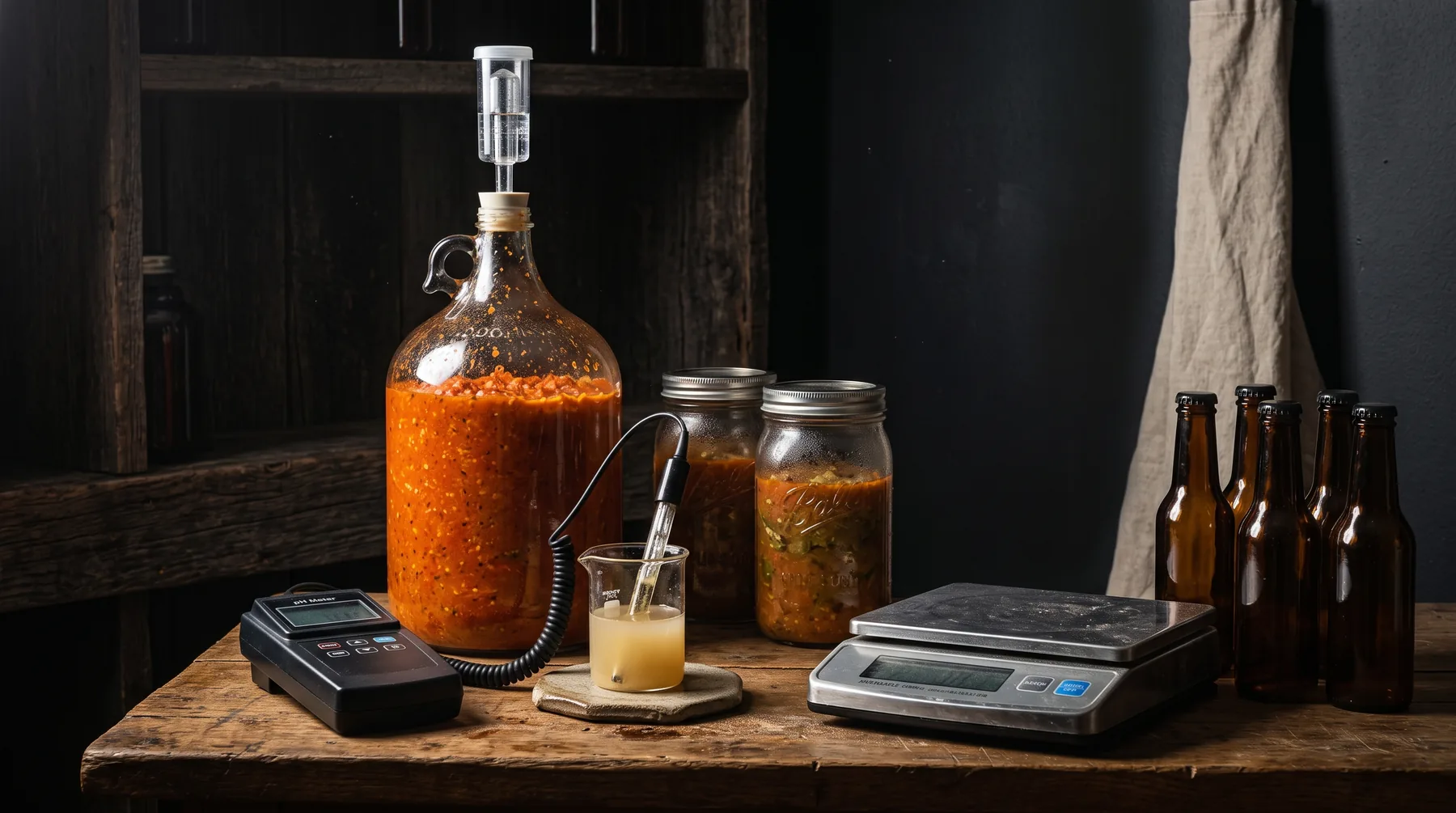
Everything to run a real hot sauce ferment, from a gram scale to a calibrated pH meter. Kitchen-only — no growing gear, for people who already have chiles.
13 pieces · bought separately, chosen to work together
No seeds, no soil, no lights. This is the kitchen half of the pipeline, for someone who already has chiles — from their own garden, a farmers’ market, or a very good late-summer produce aisle.
Why we bundled it this way
Three conditions do all the work in a lacto-ferment, and each item here holds one of them steady:
Salt at the right percentage. The gram scale is the safety item, not a convenience. Brine strength is a percentage of total weight, and a cup of kosher salt is not the same amount of salt as a cup of table salt. Canning salt because iodine suppresses the lactobacillus you are cultivating.
No oxygen. Airlock lids let CO₂ out without letting air in. Glass weights hold everything under the brine — and almost every failed ferment is something that floated. Glass because it is inert in an acid brine.
A pH you can actually read. Both tiers are here on purpose. The strips are 0–6 short range, which is genuinely adequate for confirming a ferment at 3.2 is well clear of 4.6. The meter is for anyone who wants ±0.1 — which you need if a reading lands anywhere near the line, and which you must have before you consider anything shelf-stable. Buy the buffers with the meter; an uncalibrated meter is worse than strips because you will trust it.
A vessel that fits a real batch. Ten pounds of chiles do not go in a quart jar. The gallon fermenter is the batch vessel; the mason jar kit covers small experiments and the second batch you inevitably start.
The high-speed blender is here because chile skin needs a full two minutes at speed to emulsify — under-blending is why home hot sauce separates in the bottle. The strainer and woozy bottles are what turn it from a thick paste into something that pours.
What it produces
Any of the fermented sauces on this site. A one-gallon ferment yields roughly eight to twelve 5 oz bottles.
What it does not do
It does not can anything. Fermented hot sauce is a refrigerator product here — a finished pH of 3.2 keeps it safe and excellent for over a year in the fridge, but a tested shelf-stable process is a different thing and we do not publish one. See the acid math for why that distinction is real.
What this kit makes
What's in the kit
This is a curated set, not an Amazon bundle — each piece is its own listing, so you can skip anything you already own. They're listed in the order you'll use them.
Amazon supports up to 10 items per add-to-cart link; add each group to the same cart. Amazon opens your cart for review.
FINITEX
Nitrile Exam Gloves, 200 pcs, food-safe
Paid link · commission may be earned
Capsaicin is oil-soluble and does not wash off with soap. Seeding a pound of habaneros bare-handed means eight hours of burning hands and one unforgettable mistake involving your own eye.
Why this one
- Nitrile blocks capsaicin oil where latex and vinyl leak
- Food-safe rated
- 200 per box — you will use them
The tradeoff
- Change them if you tear one; capsaicin finds the hole
- Ventilate the kitchen too — blitzing superhots aerosolises capsaicin
Etekcity
Digital Kitchen Scale, 11 lb, g/oz
Paid link · commission may be earned
Fermentation brine is a percentage of weight, not a number of spoons. Without a gram scale you are not following a fermentation recipe — you are guessing at the one number that determines whether it is safe.
Why this one
- 1 g resolution, which is what a 2.5% brine calculation actually needs
- Tare function for weighing into a vessel
- 11 lb capacity covers a full sauce batch
The tradeoff
- 11 lb ceiling — a 20-pound tomato haul needs two weighings
- Battery-powered; keep spares
Morton
Canning & Pickling Salt, 4 lb ×4
Paid link · commission may be earned
Table salt carries iodine and anti-caking agents. Iodine suppresses the lactobacillus you are trying to cultivate and the anti-caking agent turns your brine cloudy grey.
Why this one
- Pure sodium chloride — nothing that interferes with a ferment
- Fine grain dissolves without heating the brine
- Bulk: a serious ferment season eats salt
The tradeoff
- Fine grain means volume measures differ from kosher salt — weigh it, always
- Four 4-lb boxes is a lot of salt for one season
FastRack
1-Gallon Fermenting Jar with Twin-Bubble Airlock
Paid link · commission may be earned
Ten pounds of habaneros does not fit in a quart jar. A gallon vessel is what a real hot-sauce batch needs, and glass lets you watch the ferment instead of guessing.
Why this one
- A full sauce batch in one vessel — no splitting across four jars
- Glass shows you the bubble activity and the brine line
- Far cheaper than a stoneware crock
The tradeoff
- Fill an airlock with water or vodka, never leave it dry
- Awkward to clean; a bottle brush is required
Masontops
Complete Mason Jar Fermentation Kit
Paid link · commission may be earned
Fermentation is anaerobic. An airlock lets CO₂ out without letting oxygen in, which is the entire difference between a clean lacto-ferment and a jar of kahm yeast and mould.
Why this one
- Airlock lids plus weights — the two things that decide whether a ferment goes right
- Fits jars you already own instead of a dedicated crock
- Silicone pipes need no water topping-up, unlike three-piece airlocks
The tradeoff
- Wide-mouth jars only
- A crock is better for volumes above a gallon; this is the 1–2 quart tool
SOLIGT
Glass Fermentation Weights, 4-Pack
Paid link · commission may be earned
Anything floating above the brine will mould. A glass weight holds the chile mash under the surface for three weeks without you touching it, which is the whole job.
Why this one
- Glass is inert — no metal reacting with an acid brine
- Grip handle means you can lift it out of a full jar without a fight
- Sized for wide-mouth jars
The tradeoff
- Wide-mouth only
- A sandwich bag of brine works in a pinch, but it will eventually leak
Apera Instruments
AI311 PH60 Waterproof Pocket pH Tester
Paid link · commission may be earned
The 4.6 line is not a guideline, it is the number below which Clostridium botulinum cannot grow. Strips get you to half a pH point. This gets you to ±0.1, and for anything you intend to keep, that difference is the whole ballgame.
Why this one
- ±0.1 pH accuracy with a replaceable probe
- Auto-calibration against standard buffers
- Waterproof body that survives a sauce kitchen
The tradeoff
- Must be calibrated before every session — an uncalibrated meter is worse than strips because you'll trust it
- The probe is a consumable; store it wet in storage solution, never dry
- Real money. If you are only ever going to refrigerate, strips are enough.
Apera Instruments
AI1113 pH Calibration Buffer Kit (4.00 / 7.00)
Paid link · commission may be earned
A pH meter is only as honest as its last calibration. Two-point calibration at 4.00 and 7.00 brackets the entire range a sauce ever lives in.
Why this one
- 4.00 and 7.00 bracket the acid range that matters for food
- 8 oz of each — a season's worth of calibrations
- Matched to the meter above
The tradeoff
- Buffer degrades once opened; date the bottles and replace annually
- Never pour used buffer back into the bottle
MicroEssential
Hydrion Short-Range pH Strips, 0.0–6.0
Paid link · commission may be earned
The budget answer, and a genuinely usable one: a 0–6 range in 0.5 steps tells you whether a ferment has crossed 4.6. Universal 1–14 strips cannot — they are useless for this job.
Why this one
- Short range means readable half-point resolution where it matters
- 15 ft roll in a dispenser — hundreds of tests for the price of a lunch
- No calibration, no batteries, no probe to kill
The tradeoff
- 0.5 pH resolution. Fine for confirming a ferment is well under 4.6; not enough for a reading that lands near it.
- Coloured sauce stains the strip and makes reading harder — test the brine, not the mash
Vitamix
5200 Professional-Grade Blender, 64 oz
Paid link · commission may be earned
The difference between a hot sauce that is smooth and one that is smooth-ish is blade tip speed. A Vitamix emulsifies chile skin into the sauce so completely you do not need to strain it.
Why this one
- Genuinely emulsifies skin and pulp — no straining step, no separation in the bottle
- 64 oz handles a full batch in one go
- Repairable, with a seven-year warranty and decades of real-world service life
The tradeoff
- Five hundred dollars. The immersion blender below does 80% of this for a tenth of the price.
- Loud enough to be an event
Cuisinart
Mesh Strainers, Stainless, 3-Count
Paid link · commission may be earned
The last pass before bottling. A fine mesh catches the skin fragments and seed shards that make a hot sauce gritty and clog a woozy bottle's dripper insert.
Why this one
- Three sizes cover straining, sifting and rinsing
- Stainless — non-reactive with a high-acid sauce
- Fine enough to catch what the blender missed
The tradeoff
- Straining costs you yield — expect to lose 10–15% of volume
- Push it through with a ladle, don't wait for gravity
nicebottles
Woozy Hot Sauce Bottles, 5 oz, 24-Pack
Paid link · commission may be earned
A hot sauce in a mason jar is a condiment you spoon. In a woozy bottle with a dripper insert it is a hot sauce — and dripper control is the difference between seasoning food and ruining it.
Why this one
- Dripper inserts give you drop-level control on a 200,000 SHU sauce
- Glass, so it will not stain or hold odour like PET
- 24 is roughly two batches, which is the gifting quantity
The tradeoff
- Woozies are for finished, strained, thin sauces. A chunky salsa will clog the insert.
- Sterilise before filling — a bottle is not a canning jar and will not process
WSICSE
Canning Jar Labels, 360 pcs, removable
Paid link · commission may be earned
Date every jar. In March, three jars of red sauce are indistinguishable, and 'it's probably the one from August' is not a food-safety practice.
Why this one
- Removable adhesive — jars come clean for the next season
- 360 labels covers years
- Writable surface that survives the fridge
The tradeoff
- Label AFTER processing and cooling; adhesive fails in a boiling water bath
Paid links. As an Amazon Associate I earn from qualifying purchases. Amazon is the seller of every item; we hold no inventory and ship nothing. Check listings for current details. Full disclosure. Reviewed 2026-09-01.