
Kit · Windowsill
The Windowsill Hot Sauce Start
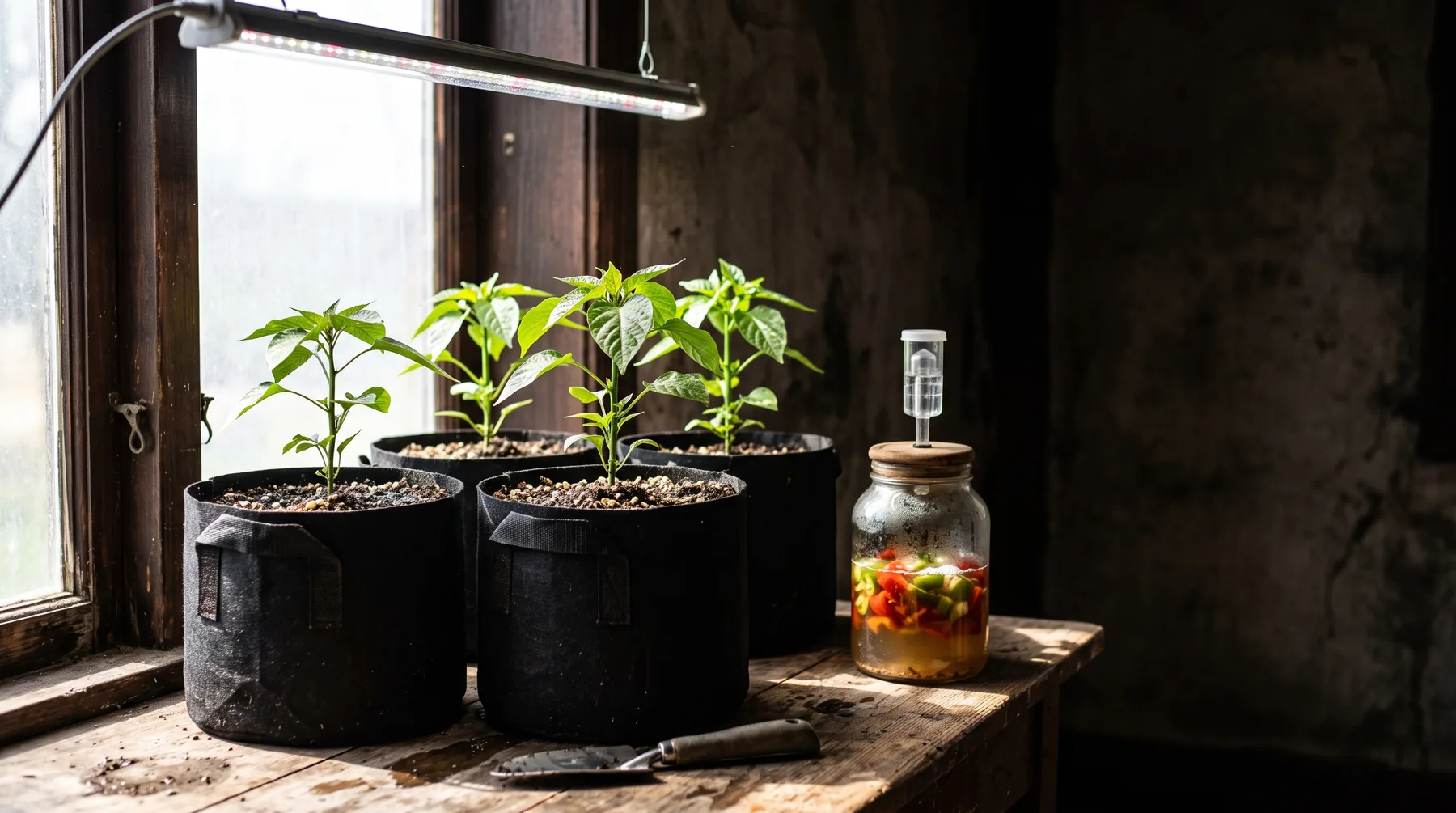
Three plants, a shelf, a light and a jar. The smallest setup that genuinely ends in a bottle of fermented hot sauce, for people with no garden at all.
17 pieces · bought separately, chosen to work together
No garden, no bed, no yard. A bright south-facing window or a shelf with a light, three fabric pots, and about eight months.
That is genuinely enough to end up with your own fermented hot sauce, and this is the smallest honest version of that.
Why we bundled it this way
The constraint is light, and everything else follows from it. Three plants is the realistic ceiling for a windowsill, so this kit is scoped to a single-batch sauce rather than a shelf of jars.
The two purchases people try to cut are exactly the two that decide the outcome:
- The heat mat with a thermostat. Habanero seed at 68 °F germinates in a month, if at all. At 85 °F it is up in a fortnight. Indoors, in February, without a mat, your soil is at room temperature. This is the whole ballgame.
- The LED strip. A February window is a fraction of the light a seedling needs, from one direction, and it stretches toward it and never recovers. Two inches away, sixteen hours a day.
Everything else here is cheap. The gram scale is the safety item — brine is a percentage of weight, and spoons are not a measurement. The pH strips are the budget tier deliberately: for a refrigerated sauce, confirming you are well under 4.6 is enough, and an $80 meter is a later purchase.
What it produces
About five to eight 5 oz bottles of fermented hot sauce, from roughly one pound of habaneros across three plants.
What it does not do
It does not grow tomatoes. Indeterminate paste tomatoes need ten gallons of root volume, eight hours of direct sun and six feet of vertical support, and a windowsill has none of those. If tomato sauce is the goal, this is the wrong kit.
The timeline
Roughly February to September. Sow ten weeks before your last frost, move the pots outside or to the brightest window after it, first pods in August, ferment for four weeks, bottle in September.
Run it through the Plan Builder for dates in your zone.
What this kit makes
What's in the kit
This is a curated set, not an Amazon bundle — each piece is its own listing, so you can skip anything you already own. They're listed in the order you'll use them.
Amazon supports up to 10 items per add-to-cart link; add each group to the same cart. Amazon opens your cart for review.
Sow Right Seeds
Habanero Orange Pepper Seed
Paid link · commission may be earned
The workhorse superhot for sauce: 100,000–350,000 SHU with a genuine apricot-floral top note that survives fermentation. Nothing else in this range tastes like fruit instead of pure burn.
Why this one
- Capsicum chinense — the fruity species, not the flat heat of an annuum
- 90–100 days from transplant, so it fits a Zone 5 season if you start on time
- Packet-scale quantity: you need six plants, not six hundred seeds
The tradeoff
- Germinates slowly and sulks below 80 °F soil — a heat mat is not optional for this one
- Superhot seed is worth starting 10 weeks out, not 8
Espoma
Organic Seed Starter Potting Mix
Paid link · commission may be earned
Seed-starting mix is not potting soil with a nicer label — it is finer, lighter, and low in nutrients on purpose, because a seedling's first roots want air and moisture, not fertiliser.
Why this one
- Fine texture holds contact with a small seed without crusting
- Low nutrient load — high-salt potting soil burns new roots
- Sphagnum/perlite base drains fast enough to keep damping-off down
The tradeoff
- Because it is low-nutrient, seedlings need feeding from true-leaf stage onward
- Wet it thoroughly and let it sit an hour before filling cells; dry peat repels water
VIVOSUN
Seedling Heat Mat + Digital Thermostat
Paid link · commission may be earned
Peppers germinate on soil temperature, not air temperature. At 65 °F a habanero takes a month and half of them rot; at 85 °F it is up in eight days. The thermostat is the half that matters.
Why this one
- Thermostat with a soil probe — a bare mat runs hot and cooks seed
- Holds 80–90 °F, the actual germination band for Capsicum chinense
- 10×20.75" fits a standard 1020 tray exactly
The tradeoff
- Turn it off once seedlings emerge; bottom heat after germination makes leggy stems
- The probe must sit in the medium, not on the tray, or it reads the room
Barrina
T8 Full-Spectrum Grow Lights, 1 ft 4-pack
Paid link · commission may be earned
A south window in March delivers a fraction of the light a pepper seedling needs, and the plant tells you by stretching. Two inches of LED above the canopy for 16 hours a day fixes it permanently.
Why this one
- 5000K full spectrum is genuinely adequate for seedlings — you do not need a blurple panel
- Link end to end to cover a whole shelf on one outlet
- Runs cool enough to sit 2–3" off the canopy
The tradeoff
- Not a flowering light — this is for the propagation stage, not fruiting indoors
- 1 ft sections: buy for your actual shelf length
Bootstrap Farmer
72-Cell Trays with 1020 Bottoms, 5-Pack
Paid link · commission may be earned
The cheap black nursery trays crack after one season and flex enough to break roots when you lift them. These do not. Over five seasons the price per use is lower than the throwaways.
Why this one
- Thick, genuinely reusable plastic — the standard against which cheap trays are measured
- 72 cells is the right density for peppers and tomatoes to true-leaf stage
- 1020 footprint fits every heat mat, dome and light on this site
The tradeoff
- Real money up front against $8 flimsy trays
- 72 small cells means you must pot up before transplant; peppers outgrow them
Xgunion
T-Type Plant Labels, 200 pcs + Marker
Paid link · commission may be earned
Six pepper seedlings look identical for eleven weeks. Ask anyone who has planted a habanero where the Marconi should have gone.
Why this one
- Included marker is genuinely permanent — pencil and Sharpie both fade by July
- T-shape stays legible above the canopy
- 200 covers several seasons
The tradeoff
- UV eventually takes the ink; re-label anything you're carrying into a second year
VIVOSUN
5-Gallon Fabric Grow Bags, 5-Pack
Paid link · commission may be earned
Fabric pots air-prune roots and drain faster than a plastic pot can, which is the entire reason container tomatoes fail. Five gallons is the honest minimum for a pepper; a tomato wants ten.
Why this one
- Air pruning gives a dense fibrous root ball instead of a spiral
- Drains hard — near-impossible to waterlog
- Fold flat for winter storage
The tradeoff
- Dry out much faster than plastic — in July a 5-gallon bag can need daily water
- 5 gal is right for peppers, tight for an indeterminate tomato
FoxFarm
Ocean Forest Potting Soil
Paid link · commission may be earned
Pre-charged with enough nutrition to carry a transplant for its first month without feeding, which is exactly the window when most container plants stall.
Why this one
- Aerated, fast-draining base — will not compact into a brick by August
- Comes charged: no feeding needed for the first 30 days
- Consistent bag to bag, which cheap mixes are not
The tradeoff
- Rich enough to burn seedlings — this is a transplant mix, not a seed-starting mix
- 1.5 ft³ per bag; a 5-gallon bag of soil takes about half of one
Espoma
Organic Tomato-Tone 3-4-6 with 8% Calcium
Paid link · commission may be earned
The NPK ratio is the point: low nitrogen, higher potassium. Feed a tomato a high-nitrogen lawn fertiliser and you get a magnificent six-foot plant with four tomatoes on it.
Why this one
- 3-4-6 pushes fruit rather than foliage
- 8% calcium directly addresses the blossom-end-rot pathway
- Slow release — feed monthly, not weekly
The tradeoff
- Granular and slow; it will not rescue a plant that is already deficient
- Works on peppers too, at about two-thirds the tomato rate
SONKIR
3-in-1 Soil Moisture / Light / pH Tester
Paid link · commission may be earned
Used for one thing — is the root zone actually dry six inches down — it prevents both halves of the most common container failure. Ignore the pH scale on it entirely.
Why this one
- Reads at root depth instead of the dry top inch you can see
- No batteries
- Instant answer to the only watering question that matters
The tradeoff
- The pH function on these is not accurate. Use the real test kit or a meter for pH.
- The light meter is decorative
FINITEX
Nitrile Exam Gloves, 200 pcs, food-safe
Paid link · commission may be earned
Capsaicin is oil-soluble and does not wash off with soap. Seeding a pound of habaneros bare-handed means eight hours of burning hands and one unforgettable mistake involving your own eye.
Why this one
- Nitrile blocks capsaicin oil where latex and vinyl leak
- Food-safe rated
- 200 per box — you will use them
The tradeoff
- Change them if you tear one; capsaicin finds the hole
- Ventilate the kitchen too — blitzing superhots aerosolises capsaicin
Etekcity
Digital Kitchen Scale, 11 lb, g/oz
Paid link · commission may be earned
Fermentation brine is a percentage of weight, not a number of spoons. Without a gram scale you are not following a fermentation recipe — you are guessing at the one number that determines whether it is safe.
Why this one
- 1 g resolution, which is what a 2.5% brine calculation actually needs
- Tare function for weighing into a vessel
- 11 lb capacity covers a full sauce batch
The tradeoff
- 11 lb ceiling — a 20-pound tomato haul needs two weighings
- Battery-powered; keep spares
Morton
Canning & Pickling Salt, 4 lb ×4
Paid link · commission may be earned
Table salt carries iodine and anti-caking agents. Iodine suppresses the lactobacillus you are trying to cultivate and the anti-caking agent turns your brine cloudy grey.
Why this one
- Pure sodium chloride — nothing that interferes with a ferment
- Fine grain dissolves without heating the brine
- Bulk: a serious ferment season eats salt
The tradeoff
- Fine grain means volume measures differ from kosher salt — weigh it, always
- Four 4-lb boxes is a lot of salt for one season
Masontops
Complete Mason Jar Fermentation Kit
Paid link · commission may be earned
Fermentation is anaerobic. An airlock lets CO₂ out without letting oxygen in, which is the entire difference between a clean lacto-ferment and a jar of kahm yeast and mould.
Why this one
- Airlock lids plus weights — the two things that decide whether a ferment goes right
- Fits jars you already own instead of a dedicated crock
- Silicone pipes need no water topping-up, unlike three-piece airlocks
The tradeoff
- Wide-mouth jars only
- A crock is better for volumes above a gallon; this is the 1–2 quart tool
SOLIGT
Glass Fermentation Weights, 4-Pack
Paid link · commission may be earned
Anything floating above the brine will mould. A glass weight holds the chile mash under the surface for three weeks without you touching it, which is the whole job.
Why this one
- Glass is inert — no metal reacting with an acid brine
- Grip handle means you can lift it out of a full jar without a fight
- Sized for wide-mouth jars
The tradeoff
- Wide-mouth only
- A sandwich bag of brine works in a pinch, but it will eventually leak
MicroEssential
Hydrion Short-Range pH Strips, 0.0–6.0
Paid link · commission may be earned
The budget answer, and a genuinely usable one: a 0–6 range in 0.5 steps tells you whether a ferment has crossed 4.6. Universal 1–14 strips cannot — they are useless for this job.
Why this one
- Short range means readable half-point resolution where it matters
- 15 ft roll in a dispenser — hundreds of tests for the price of a lunch
- No calibration, no batteries, no probe to kill
The tradeoff
- 0.5 pH resolution. Fine for confirming a ferment is well under 4.6; not enough for a reading that lands near it.
- Coloured sauce stains the strip and makes reading harder — test the brine, not the mash
nicebottles
Woozy Hot Sauce Bottles, 5 oz, 24-Pack
Paid link · commission may be earned
A hot sauce in a mason jar is a condiment you spoon. In a woozy bottle with a dripper insert it is a hot sauce — and dripper control is the difference between seasoning food and ruining it.
Why this one
- Dripper inserts give you drop-level control on a 200,000 SHU sauce
- Glass, so it will not stain or hold odour like PET
- 24 is roughly two batches, which is the gifting quantity
The tradeoff
- Woozies are for finished, strained, thin sauces. A chunky salsa will clog the insert.
- Sterilise before filling — a bottle is not a canning jar and will not process
Paid links. As an Amazon Associate I earn from qualifying purchases. Amazon is the seller of every item; we hold no inventory and ship nothing. Check listings for current details. Full disclosure. Reviewed 2026-09-01.