Guide · growing
How to grow mustard from seed—and make your own mustard
A seed-to-condiment field guide: cool-season mustard greens, a crop grown for mature seed, harvest timing, and three refrigerator mustard recipes with weights, ratios, and storage rules.
Mustard is two crops wearing one name.
Grow it for leaves and you have one of the fastest cool-season greens in the garden: seed to baby leaf in about 21–30 days, full-size leaves in roughly 40–45 days. Grow it for seed and you are committing to a taller, flowering plant that needs a longer spring or fall window, dry weather at maturity, and a little threshing work.
The payoff is unusually complete: peppery leaves in the cool months, edible flower shoots if you catch them early, and seed for a jar of mustard that tastes like the plant you grew rather than yellow paint and vinegar.
Pick the mustard you actually want
For leaves, choose a named mustard green. Garnet Giant and other Brassica juncea types give you tender, colored leaves and a useful amount of seed if you let a few plants mature. Green Wave and Florida Broadleaf are dependable green-leaf choices. Mizuna is a mustard relative with a finer leaf and a milder, more salad-friendly bite.
For condiment seed, species matters:
| Seed | Botanical name | Flavor and use |
|---|---|---|
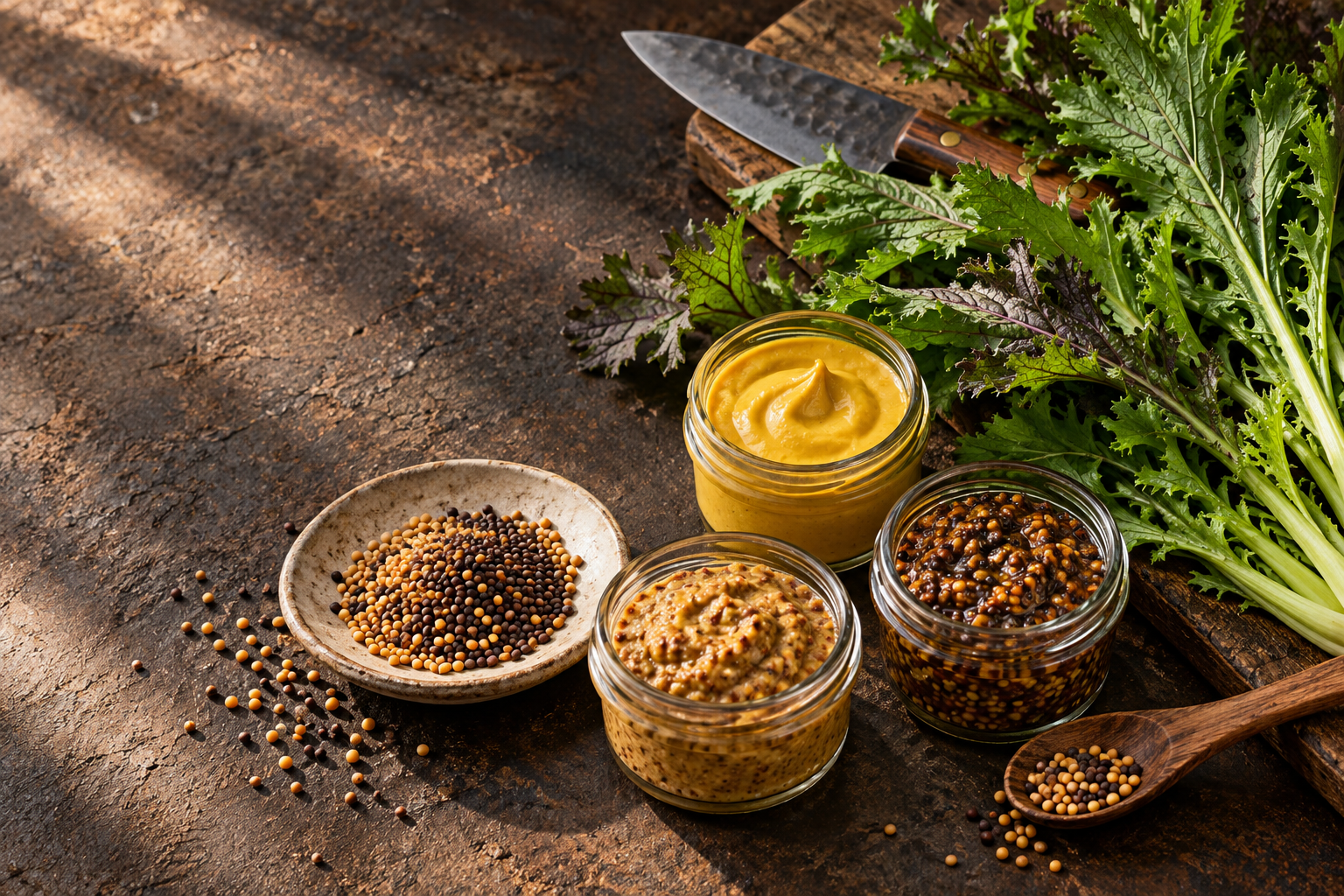
| Yellow/white | Sinapis alba | Mildest, bright yellow, the classic ballpark base |
| Brown | Brassica juncea | Hotter and more aromatic; Dijon and spicy brown territory |
| Black | Brassica nigra | Sharpest, volatile heat; use sparingly in a blend |
If you want one plant to do both jobs, use a brown mustard green. Harvest its outside leaves for weeks, then leave two or three plants untouched to flower and set pods. A plant harvested hard for greens will not produce a serious seed crop.
The growing plan
Timing: spring and fall beat summer
Mustard grows best while the mean temperature stays cool. Sow in spring as soon as the bed can be worked, or in late summer for a fall crop. Utah State University Extension lists 55–65°F as the best germination range, with emergence in 7–10 days; temperatures above 80°F reduce germination. Oregon State lists 40–45 days from seed to harvest for mustard under garden conditions.
The practical rule is simple: count backward from the first stretch of hot weather in spring, and count backward from your first hard freeze in fall. A fall crop is often the better crop because the leaves mature while nights are cool. In warm Zones 8–11, grow mustard through winter and avoid the summer entirely.
Sow directly, shallowly, and often
Mustard does not need a long indoor head start. Direct sowing avoids a transplant check and makes succession planting easy.
- Prepare a fine, firm seedbed in full sun. Mustard tolerates light shade, but growth slows.
- Sow ½ inch deep in a strip or row.
- Cover the seedbed gently and keep the top inch consistently moist until emergence.
- Thin at the three- to four-leaf stage. For full-size plants, leave 3 inches between plants and 12 inches between rows. For baby leaf, sow more densely and harvest young.
- Sow a short row every 14 days while temperatures stay below the crop’s heat limit. One big planting gives you one big bolting problem; succession sowing gives you mustard for the whole cool season.
For a container, use at least 8 inches of soil depth for full-size plants. A windowsill tray can produce baby leaves, but it will not give you a meaningful seed harvest.
Soil, water, and feeding
Mustard wants fertile, well-drained soil with steady moisture. Before planting, use a soil test rather than guessing at fertilizer. Work in no more than 1 inch of finished compost per 100 square feet, then feed only if the test or crop color says the bed needs it.
The failure mode is not lack of a secret amendment. It is a dry root zone followed by heat. Keep water even, mulch lightly once seedlings are established, and harvest before the plant turns fibrous. Hot, drought-stressed mustard gets bitter and bolts early.
Protect the seedlings
Flea beetles make pinholes in young leaves and can erase a stand before it is established. Put fine insect netting or a floating row cover over the row immediately after sowing, and keep the edges sealed. Remove the cover when plants need pollination or when temperatures rise inside the tunnel.
Mustard is a brassica, so rotate it away from broccoli, cabbage, kale, and other brassicas when disease has been a problem. Water at the soil line, thin crowded plants, and remove badly diseased leaves rather than letting a wet canopy sit against itself.
Harvest the leaves without stopping the plant
Baby mustard is ready when leaves are 2–4 inches long. Full-size leaves are ready around 40–45 days, depending on variety and temperature. Cut the outside leaves first and leave the crown intact. For a once-over harvest, cut the plant 2 inches above the soil; a healthy crown may regrow.
Harvest in the morning, cool the leaves immediately, and store them unwashed in a ventilated bag. USU Extension gives mustard a storage window of 1–2 weeks at 32°F and 95% relative humidity. Wash just before cooking or eating.
If a flower stalk appears, the plant has changed jobs. Pick the tender flowering shoots for the pan, or leave the plant for seed. The leaves after bolting are edible, but they are tougher and more bitter.
Grow mustard for seed
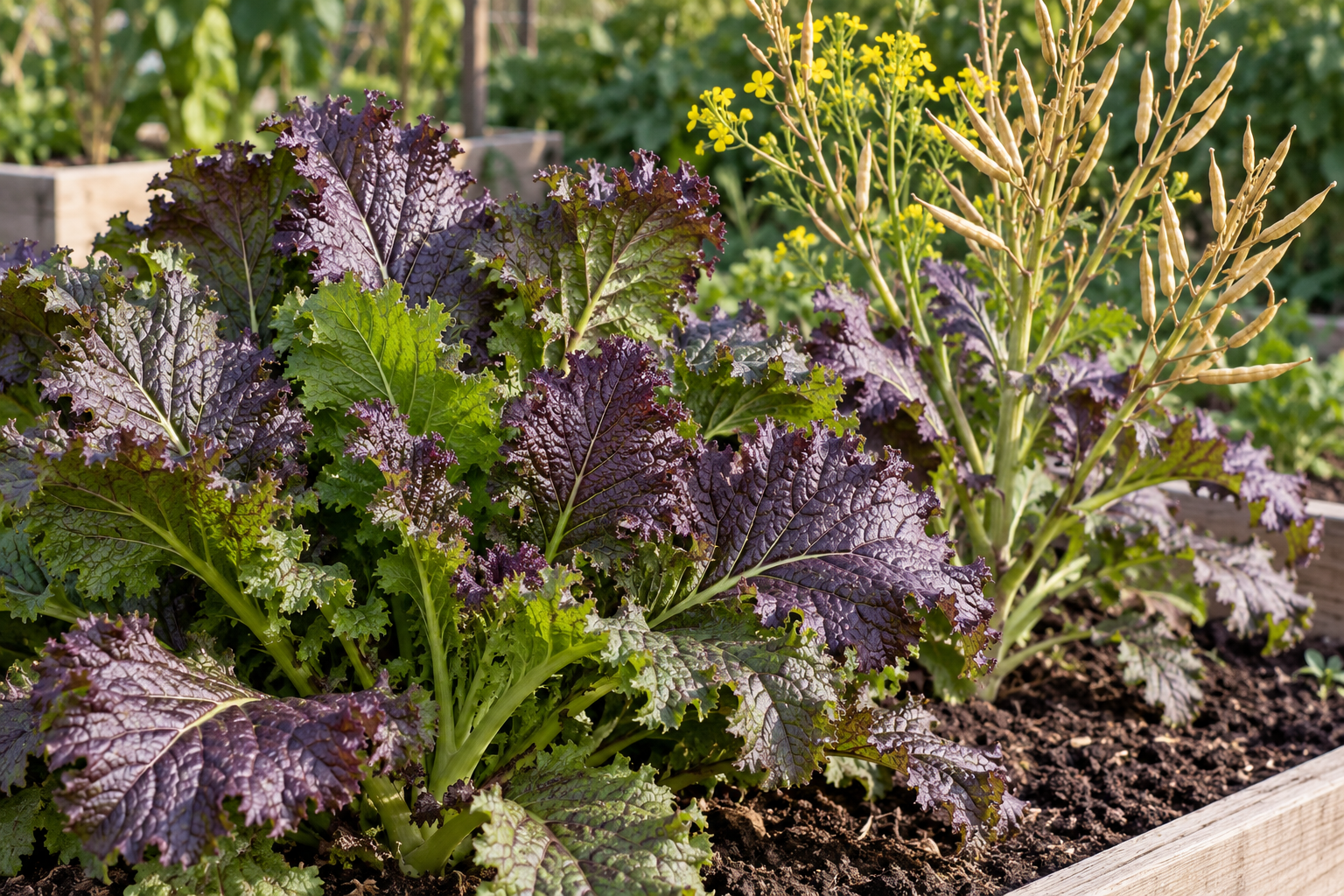
Seed production is a different calendar from baby greens. Leave vigorous, healthy plants in place after the leaf harvest. They will send up a stalk, flower, and form slender pods. Stake them if wind is a problem.
Wait until most pods have turned tan and the seeds inside are hard. Do not pull the whole plant while the pods are green; the seed will be immature and the flavor will be flat. Cut the stalks on a dry morning, bundle them loosely, and place them in a paper bag or on a sheet in a dry, ventilated place for 1–2 weeks.
To thresh, shake the dry stalks inside the bag or rub the pods through gloved hands. Pour the mix between two bowls outdoors so the light chaff blows away, then screen out the stems. Store fully dry seed in an airtight jar, dated. Keep a small amount for planting and the rest for the kitchen.
How mustard becomes hot
Mustard heat is a reaction, not a fixed property of the dry seed. Crushing the seed lets its enzymes meet water and create the pungent compounds that make mustard hot. Acid slows that reaction and preserves the finished flavor. That is why a mustard made with water can seem explosively hot at first, while a vinegar mustard is sharper but steadier.
Grind coarsely for texture, finely for a smooth spread, or split the difference. A spice grinder is useful, but pulse in short bursts so the seed does not heat up. Warmth drives off aroma. Mix, rest, taste, and adjust after the first day.
Three complete refrigerator mustard recipes
These recipes make about 1 cup (8 ounces) each. Use clean jars and utensils. They are not tested canning recipes: label every jar, refrigerate at 40°F or below, and use within 4–6 weeks for best quality. If mold, gas, or an off smell appears, discard the whole jar.
1. Yellow mustard: bright, smooth, and familiar
Ingredients
- 90 g yellow mustard seed
- 120 g 5% distilled white vinegar
- 60 g cold water
- 12 g honey
- 5 g fine salt
- 1 g turmeric, for color
Method
- Combine the seed, vinegar, and water in a glass or stainless bowl. Cover and refrigerate for 12–24 hours.
- Blend with the honey, salt, and turmeric until smooth. Add 5–10 g water if the blender stalls.
- Transfer to a clean half-pint jar. Rest 24–48 hours before judging the heat; the flavor will round out as the seed hydrates.
This is the all-purpose mustard for sausages, sandwiches, potato salad, and a pan sauce. The turmeric gives it the color people expect; it is not there to supply heat.
2. Whole-grain brown mustard: coarse, sharp, and good with roast meat
Ingredients
- 60 g brown mustard seed
- 30 g yellow mustard seed
- 100 g 5% apple cider vinegar
- 35 g dry white wine or water
- 12 g maple syrup
- 5 g fine salt
- 1 g cracked black pepper
Method
- Combine both seeds, vinegar, and wine or water. Cover and refrigerate for 24 hours.
- Pulse in a food processor 8–12 times. Stop while about one-third of the seeds remain visibly whole.
- Stir in the maple syrup, salt, and pepper. Jar, label, and refrigerate for 48 hours before serving.
The brown seed brings the heat; the yellow seed keeps the texture from becoming aggressively bitter. Use it with roast pork, grilled sausages, ham, or a sharp cheese.
3. Honey-tarragon mustard: sweet enough for a glaze, acidic enough for a sandwich
Ingredients
- 70 g yellow mustard seed
- 20 g brown mustard seed
- 110 g 5% apple cider vinegar
- 45 g water
- 35 g honey
- 8 g fine salt
- 2 g dried tarragon
- 1 g garlic powder
Method
- Soak the seeds in the vinegar and water for 12–24 hours in the refrigerator.
- Blend until mostly smooth, leaving a few brown flecks for texture.
- Add honey, salt, tarragon, and garlic powder. Blend for 10 seconds, then transfer to a clean jar.
- Refrigerate 24 hours before using. Brush onto salmon or chicken only during cooking; do not use the raw condiment as a marinade for cooked food without heating it.
The honey makes this the best of the three for a glaze. Keep the heat moderate: if you want more bite, replace 10 g of yellow seed with black seed rather than adding more pepper.
Storage and the shelf-stable line
Do not confuse an acidic ingredient with a tested preservation process. These formulas contain vinegar, but they have not been validated for room-temperature storage. The University of Minnesota describes cold-fill-hold as a commercial-style process requiring a measured pH, a validated formulation, and controlled heat treatment; that is not what these home recipes do.
Refrigerate the finished mustard promptly. USDA FSIS recommends a refrigerator at 40°F or below for safe cold storage. If you want a pantry product, use a commercially tested mustard process or buy a shelf-stable mustard. Do not improvise a canning time for a recipe containing mustard seed, honey, herbs, or fresh vegetables.
Mustard is a short crop with a long tail. In one cool season you can eat the leaves, collect the seed, and turn a few grams of it into a condiment that keeps the garden’s flavor on the table long after the bed is empty.
Related crops
Related sauces
Sources
Every food-safety number on this page traces to one of these. If you are going to trust one link on this site, trust these over us.
- Utah State University Extension — How to Grow Mustard in Your Garden
- Utah State University Extension — Leafy Greens Planting and Spacing
- Oregon State University Extension — An educator's guide to vegetable gardening
- USDA FSIS — Leftovers and Food Safety
- University of Minnesota Extension — Preserving food using cold-fill hold
The gear this guide assumes
Organic Seed Starter Potting MixMust have
Seed-starting mix is not potting soil with a nicer label — it is finer, lighter, and low in nutrients on purpose, because a seedling's first roots want air and moisture, not fertiliser.
72-Cell Trays with 1020 Bottoms, 5-PackMust have
The cheap black nursery trays crack after one season and flex enough to break roots when you lift them. These do not. Over five seasons the price per use is lower than the throwaways.
AG-30 Frost Protection Row Cover
AG-30 buys roughly 6 °F of frost protection while passing about 70% of light — enough to carry a crop through an early-October cold snap that would otherwise end your season two weeks short.
Ultra-Fine Garden Netting, 10×33 ft, 2 pcs
A hornworm is a moth's decision made in June. Fine mesh over the bed at transplant means the moth never lands, and you never spray anything at all.
6" Micro-Tip Pruning SnipsMust have
Ninety percent of sauce-garden cutting is snipping a pepper stem or a basil node, and a fine-tipped snip does it better than any pruner. Pulling peppers by hand tears the branch.
Digital Kitchen Scale, 11 lb, g/ozMust have
Fermentation brine is a percentage of weight, not a number of spoons. Without a gram scale you are not following a fermentation recipe — you are guessing at the one number that determines whether it is safe.
One-Touch Coffee & Spice Grinder
Dried cayenne into powder in fifteen seconds. Dedicate one to chiles — grind coffee in it afterwards and you will find out exactly how well capsaicin sticks to plastic.
5200 Professional-Grade Blender, 64 oz
The difference between a hot sauce that is smooth and one that is smooth-ish is blade tip speed. A Vitamix emulsifies chile skin into the sauce so completely you do not need to strain it.
Organic Distilled White Vinegar, 128 fl oz, 5% acidityMust have
The recipe calls for 5% vinegar, not a vague splash of acid. This is the clean, neutral base for yellow mustard and the easiest way to keep the ratio repeatable.
Half Pint (8 oz) Regular Mouth Mason Jars, 12Must have
Eight ounces is the right jar for a sauce you use by the spoonful. Open a quart of hot sauce and you are racing the fridge; open a half-pint and you finish it while it is still good.
Paid links. We earn a commission from Amazon if you buy; you pay the same. Disclosure.
Questions people actually ask
Can I plant grocery-store mustard seed?
Use seed sold for planting when you are growing a crop. Grocery spice seed may be viable, but the packet is not a germination guarantee and it may have been heat-treated or stored too long. For the kitchen, food-grade yellow, brown, or black seed is fine.
Does mustard survive frost?
Young mustard tolerates light frost, and cool weather improves leaf quality. A hard freeze can still damage exposed leaves, so use row cover when temperatures are headed well below 32°F.
Why is my homemade mustard bitter?
Raw mustard's heat is sharp and volatile; bitterness often comes from too much seed hull, scorched spices, old seed, or an unbalanced acid. Let the prepared mustard rest for 24–48 hours, then adjust with salt, honey, or a little more vinegar.
Can I can these mustard recipes for the pantry?
No. These are refrigerator recipes, not tested shelf-stable processes. Keep them at 40°F or below. Do not water-bath or pressure-can an improvised mustard formula; shelf stability requires a validated formulation and process.
Last reviewed 2026-09-29 by the SeedsToSauce Test Kitchen.Corrections welcome.