Sauce · Refrigerator only
Whole-Grain Garden Mustard
A sharp, coarse refrigerator mustard built from yellow and brown seed, 5% vinegar, and the mustard you can grow for leaves and seed.
Not a tested canning process
This is a refrigerator condiment, not a tested shelf-stable canning process. The vinegar is labeled 5% acidity, but the finished formula has not been validated for room-temperature storage. Keep at 40 °F or below and discard if mould, gas, or an off smell appears. Do not water-bath or pressure-can this recipe.
If you started today, in Zone 6, in pots
1 plants. 1 jars. Sauce on Jun 4.
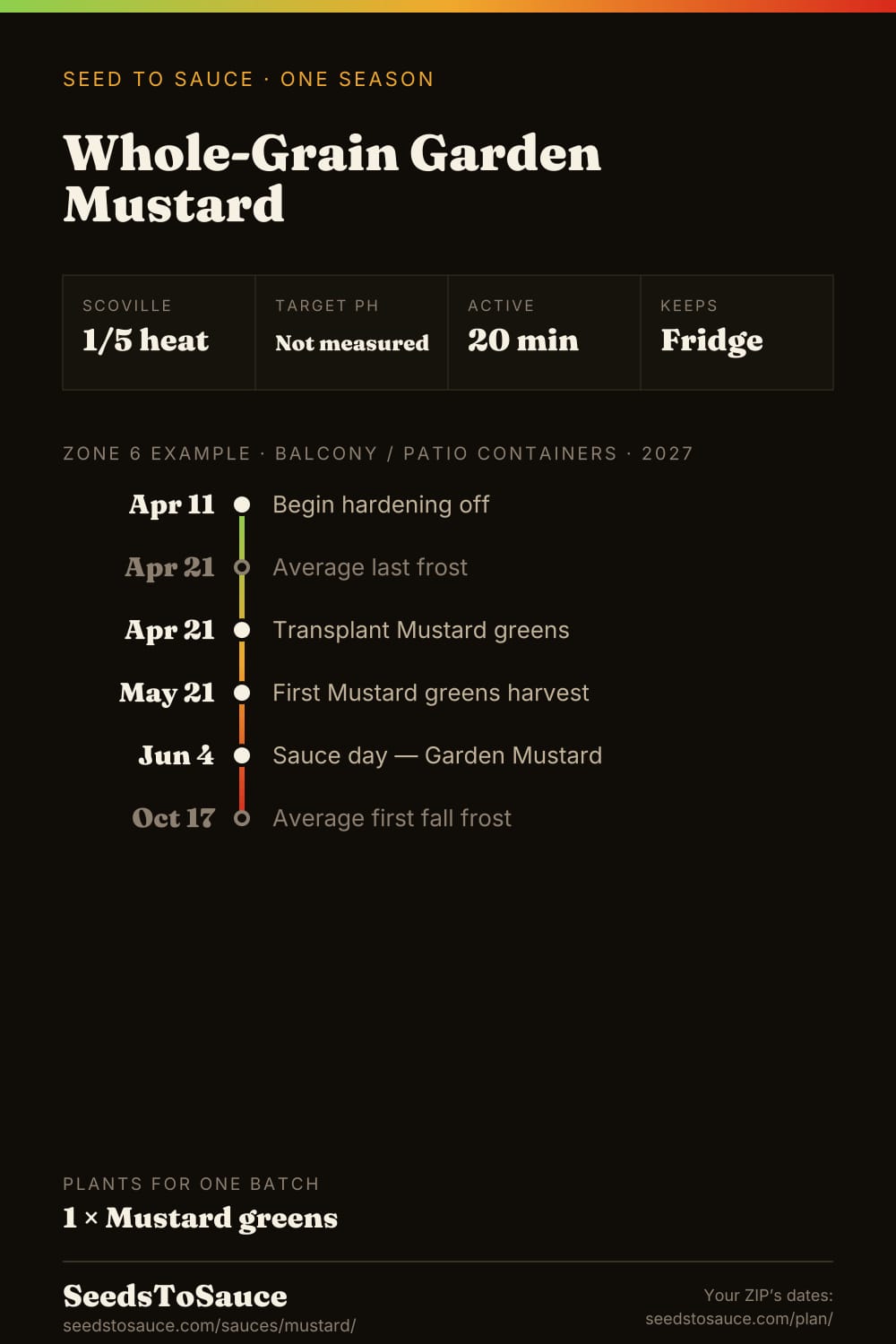
Worked from Zone 6's average last frost (Apr 21) and each cultivar's days to maturity. Your zone and your space change every date below — the builder does that for you.
- Apr 21Average last frost (Zone 6)
- May 21First Mustard greens harvest
- Jun 4Sauce day — Garden Mustard
Save it
The whole season, one pin
| Yield | About 10 oz — one 8 oz jar plus a tasting spoon — 1 half-pint jars |
|---|---|
| Active time | 20 minutes |
| Total time | 20 minutes active, 24–48 hours resting |
| Heat | Mustard heat; not measured in Scoville units |
| Target finished pH | Not measured; refrigerate |
| Preservation | Refrigerator only |
| Fruit this batch eats | 0.1 lb Mustard greens |
What you have to grow
Mustard is a sauce destination with a crop attached to it. The leaves are the fast return: baby leaf in three weeks, full-size greens in roughly six. The seed is the long game. Leave two or three plants standing after the leaf harvest, dry the pods, and you have the raw material for this jar.
The numbers
| Yield | About 10 oz — one 8 oz jar plus tasting spoon |
| Active time | 20 minutes |
| Resting time | 24–48 hours |
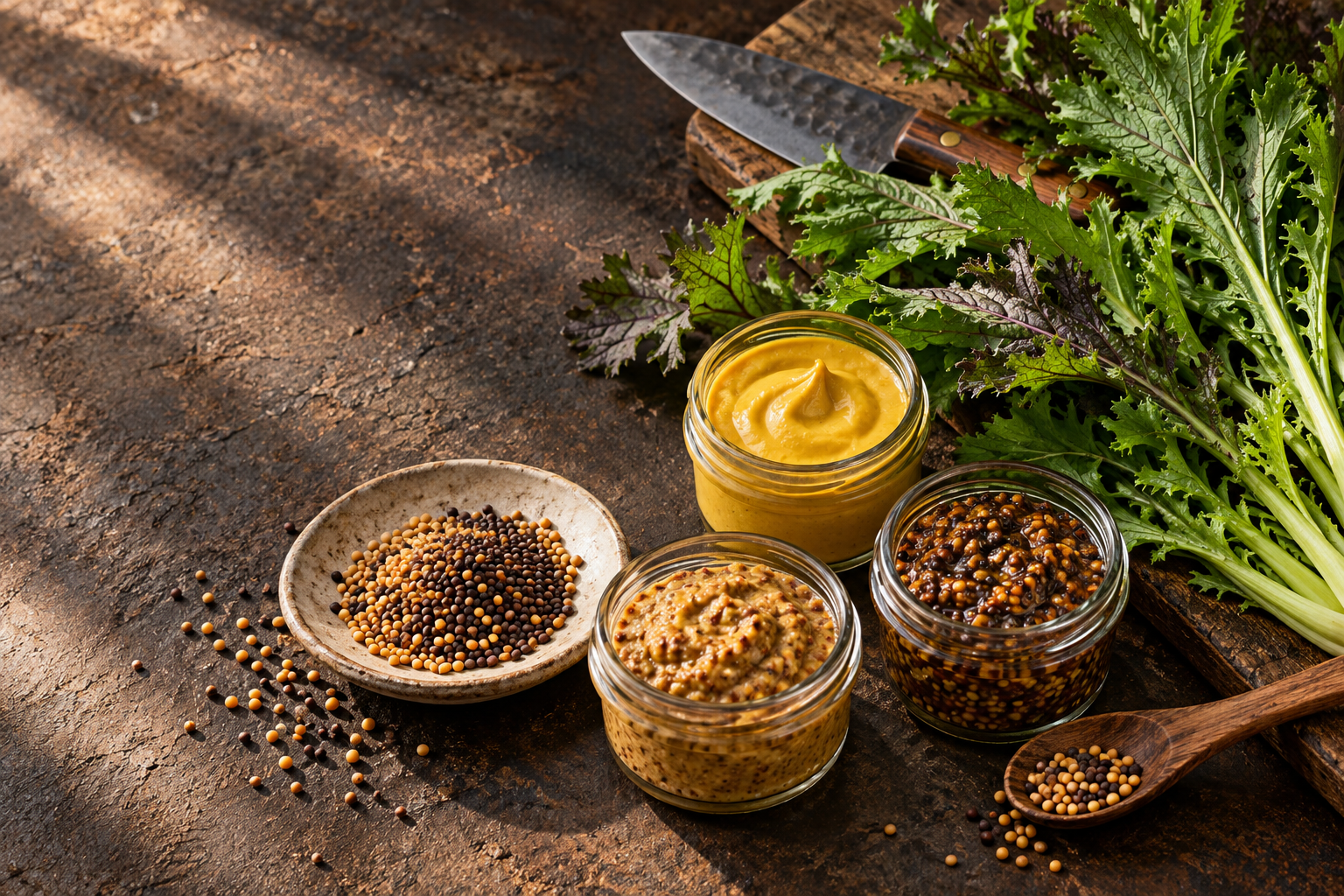
| Seed blend | 60 g brown + 30 g yellow |
| Acid | 100 g 5% apple cider vinegar |
| Preservation | Refrigerator only |
| Shelf-stable process | None; do not can this formula |
What you need
| Ingredient | Weight |
|---|---|
| Brown mustard seed | 60 g |
| Yellow mustard seed | 30 g |
| 5% apple cider vinegar | 100 g |
| Dry white wine or water | 35 g |
| Maple syrup | 12 g |
| Fine salt | 5 g |
| Cracked black pepper | 1 g |
Method
- Combine both mustard seeds, vinegar, and wine or water in a glass or stainless bowl.
- Cover and refrigerate for 24 hours. The seeds need to hydrate before they can become mustard.
- Pulse in a food processor 8–12 times. Stop while roughly one-third of the seeds remain whole.
- Stir in maple syrup, salt, and black pepper.
- Transfer to a clean 8-ounce jar, label it with the date, and refrigerate.
- Taste after 24 hours and again after 48. The first day is sharp; the second day is rounder and more integrated.
The crop behind the jar
Grow the Garnet Giant mustard grow file for fast greens and a seed reserve. Sow in spring or late summer at ½ inch deep in 55–65 °F soil. Thin to 3 inches for full-size leaves. Harvest the outside leaves and leave two or three plants alone for flowers and pods.
When most pods are tan and dry, cut the stalks on a dry day, finish drying them in a paper bag for 1–2 weeks, then shake out and screen the seed. The brown seed is hotter and more aromatic than yellow seed; blending them gives this recipe its balance.
Serving and storage
Use it with roast pork, sausages, ham, sharp cheese, or as the acid-and-fat anchor in a vinaigrette. Refrigerate promptly and keep the jar at 40 °F or below. This formula is not tested for pantry storage, and the presence of vinegar does not turn an improvised recipe into a validated canning process.
The kit for this sauce
Each item is selected for a job in this recipe. Amazon listings, sellers, and prices can change; check the current details before you buy.
Whole Yellow Mustard Seed
A food-grade yellow seed is the mild, bright base for homemade mustard. Buy seed for planting separately; a spice jar is not a germination guarantee.
Organic Seed Starter Potting MixMust have
Seed-starting mix is not potting soil with a nicer label — it is finer, lighter, and low in nutrients on purpose, because a seedling's first roots want air and moisture, not fertiliser.
AG-30 Frost Protection Row Cover
AG-30 buys roughly 6 °F of frost protection while passing about 70% of light — enough to carry a crop through an early-October cold snap that would otherwise end your season two weeks short.
Ultra-Fine Garden Netting, 10×33 ft, 2 pcs
A hornworm is a moth's decision made in June. Fine mesh over the bed at transplant means the moth never lands, and you never spray anything at all.
6" Micro-Tip Pruning SnipsMust have
Ninety percent of sauce-garden cutting is snipping a pepper stem or a basil node, and a fine-tipped snip does it better than any pruner. Pulling peppers by hand tears the branch.
Digital Kitchen Scale, 11 lb, g/ozMust have
Fermentation brine is a percentage of weight, not a number of spoons. Without a gram scale you are not following a fermentation recipe — you are guessing at the one number that determines whether it is safe.
Organic Distilled White Vinegar, 128 fl oz, 5% acidityMust have
The recipe calls for 5% vinegar, not a vague splash of acid. This is the clean, neutral base for yellow mustard and the easiest way to keep the ratio repeatable.
One-Touch Coffee & Spice Grinder
Dried cayenne into powder in fifteen seconds. Dedicate one to chiles — grind coffee in it afterwards and you will find out exactly how well capsaicin sticks to plastic.
Half Pint (8 oz) Regular Mouth Mason Jars, 12Must have
Eight ounces is the right jar for a sauce you use by the spoonful. Open a quart of hot sauce and you are racing the fridge; open a half-pint and you finish it while it is still good.
Canning Jar Labels, 360 pcs, removable
Date every jar. In March, three jars of red sauce are indistinguishable, and 'it's probably the one from August' is not a food-safety practice.
Paid links. We earn a commission from Amazon if you buy; you pay the same. Disclosure.
Questions people actually ask
Can I leave this mustard in the pantry?
No. It is a refrigerator condiment, not a tested shelf-stable process. Keep it at 40 °F or below.
Why use both yellow and brown seed?
Yellow seed supplies the bright base and brown seed supplies the sharper aroma. The blend is more useful than either seed alone.
Can I use mustard greens in the recipe?
Yes, but that becomes a different fresh green sauce. This recipe uses mature mustard seed for the classic mustard reaction and texture.
Last reviewed 2026-09-30 by the SeedsToSauce Test Kitchen. Spotted something wrong?Tell us — corrections get published.