
Sauce · Water-bath canned
Homemade Tomato Ketchup from Fresh Roma (NCHFP Tested Recipe)
Twenty-four pounds of Roma reduced by half with cider vinegar, clove, allspice and celery seed. Darker, spicier and less sweet than the bottle, and it's a tested water-bath process.
Tested process
This is the National Center for Home Food Preservation's tested "Tomato Ketchup". Pint jars, 1/8-inch headspace, boiling-water bath: 15 minutes at 0–1,000 ft, 20 minutes at 1,001–6,000 ft, 25 minutes above 6,000 ft. Use cider vinegar labelled 5% acidity, and don't reduce the vinegar or add onion, pepper or other low-acid vegetables beyond the recipe. The 1/8-inch headspace is unusually tight. That's what the test specifies, so keep to it.
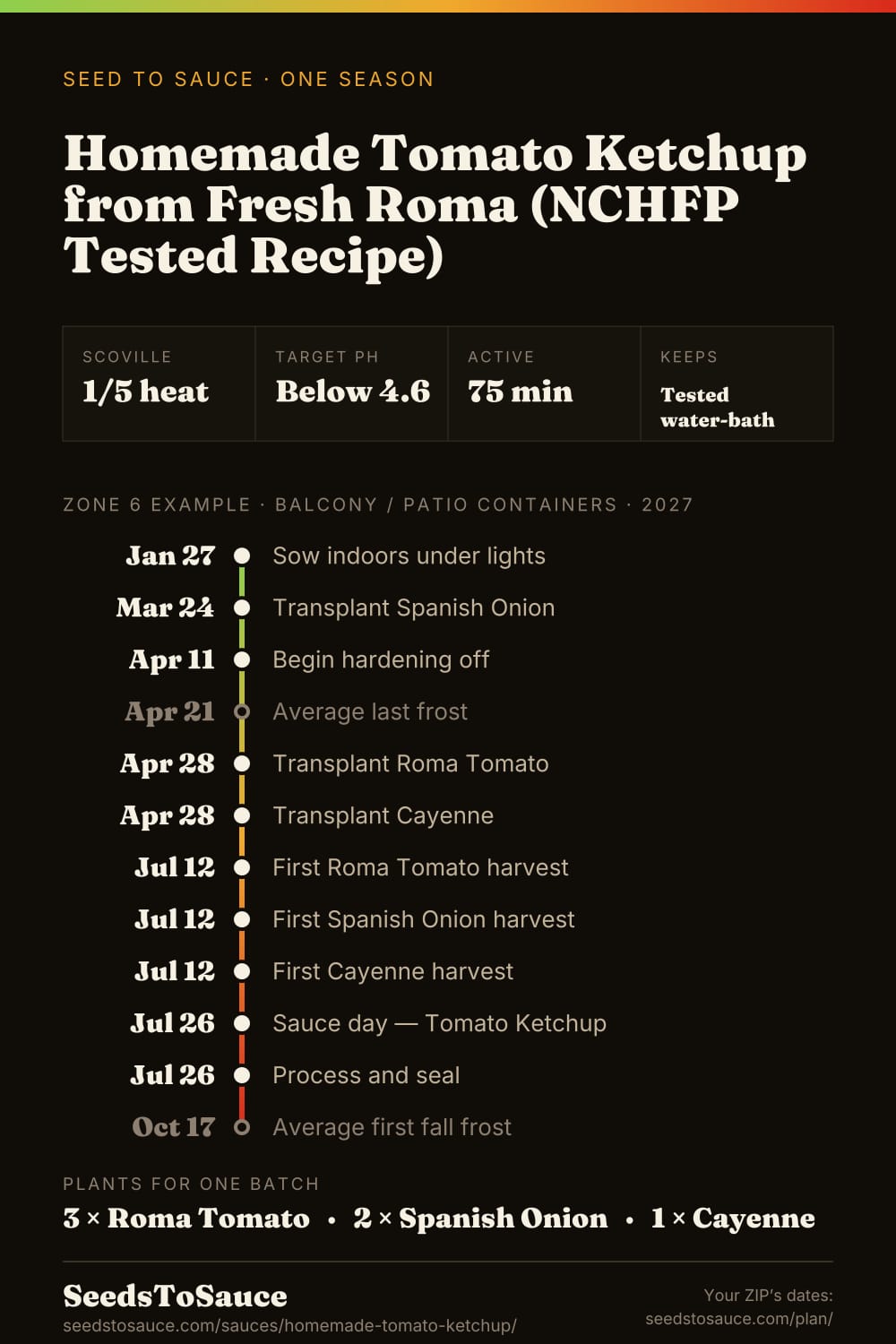
If you started today, in Zone 6, in pots
6 plants. 13 jars. Sauce on Jul 26.
Worked from Zone 6's average last frost (Apr 21) and each cultivar's days to maturity. Your zone and your space change every date below — the builder does that for you.
- Jan 6Order seeds and starting supplies
- Jan 27Sow indoors under lights
- Apr 21Average last frost (Zone 6)
- Jul 12First Roma Tomato harvest
- Jul 12First Spanish Onion harvest
- Jul 12First Cayenne harvest
- Jul 26Sauce day — Tomato Ketchup
- Jul 26Process and seal
Save it
The whole season, one pin
| Yield | About 6–7 pints — 13 half-pint jars |
|---|---|
| Active time | 75 minutes |
| Total time | 75 minutes active, about 3 hours reducing, 15 minutes processing |
| Heat | — |
| Target finished pH | Below 4.6 — fixed by the tested vinegar ratio |
| Preservation | Water-bath canned |
| Fruit this batch eats | 24 lb Roma Tomato1 lb Spanish Onion0.03 lb Cayenne |
What you have to grow
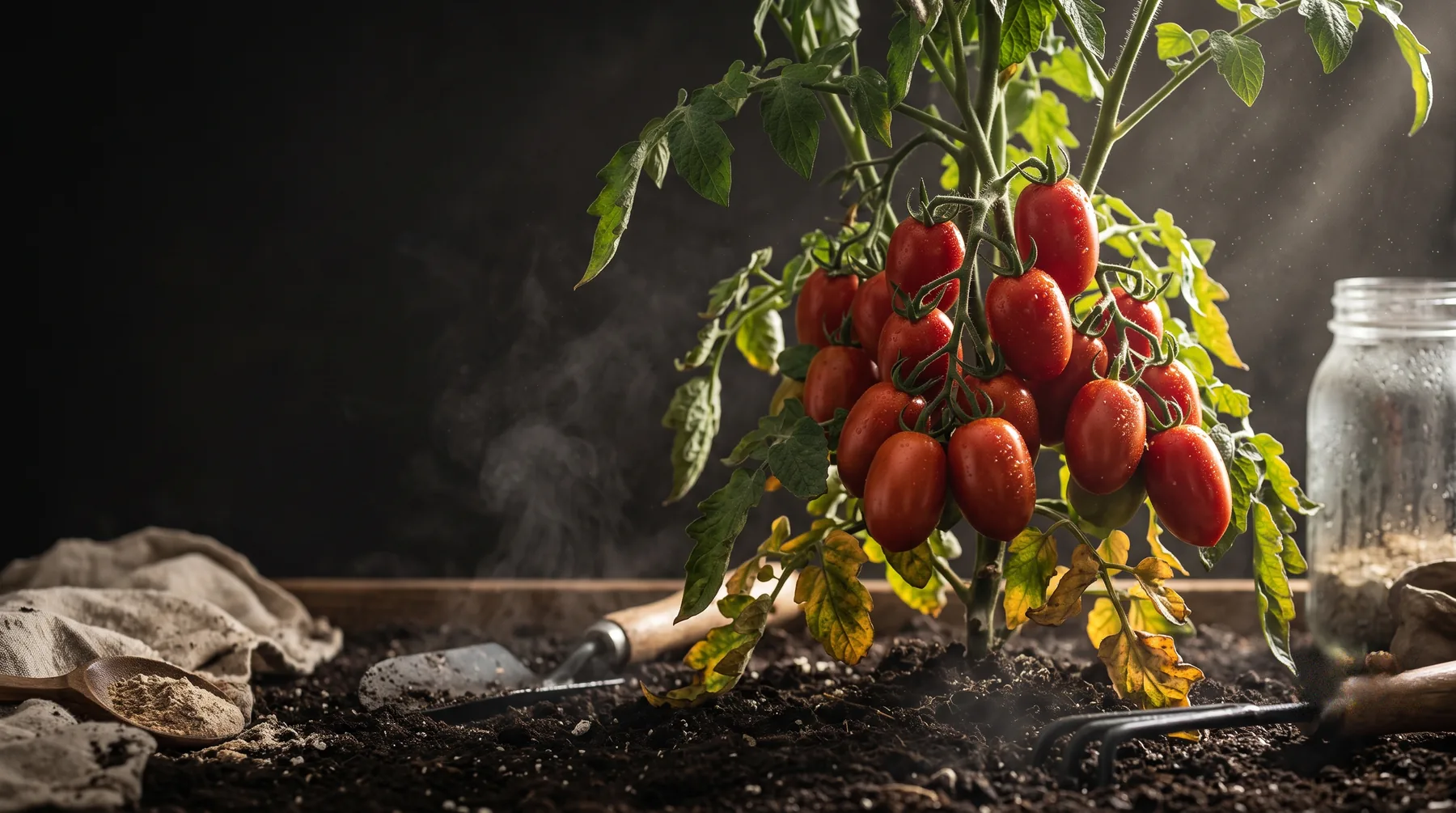
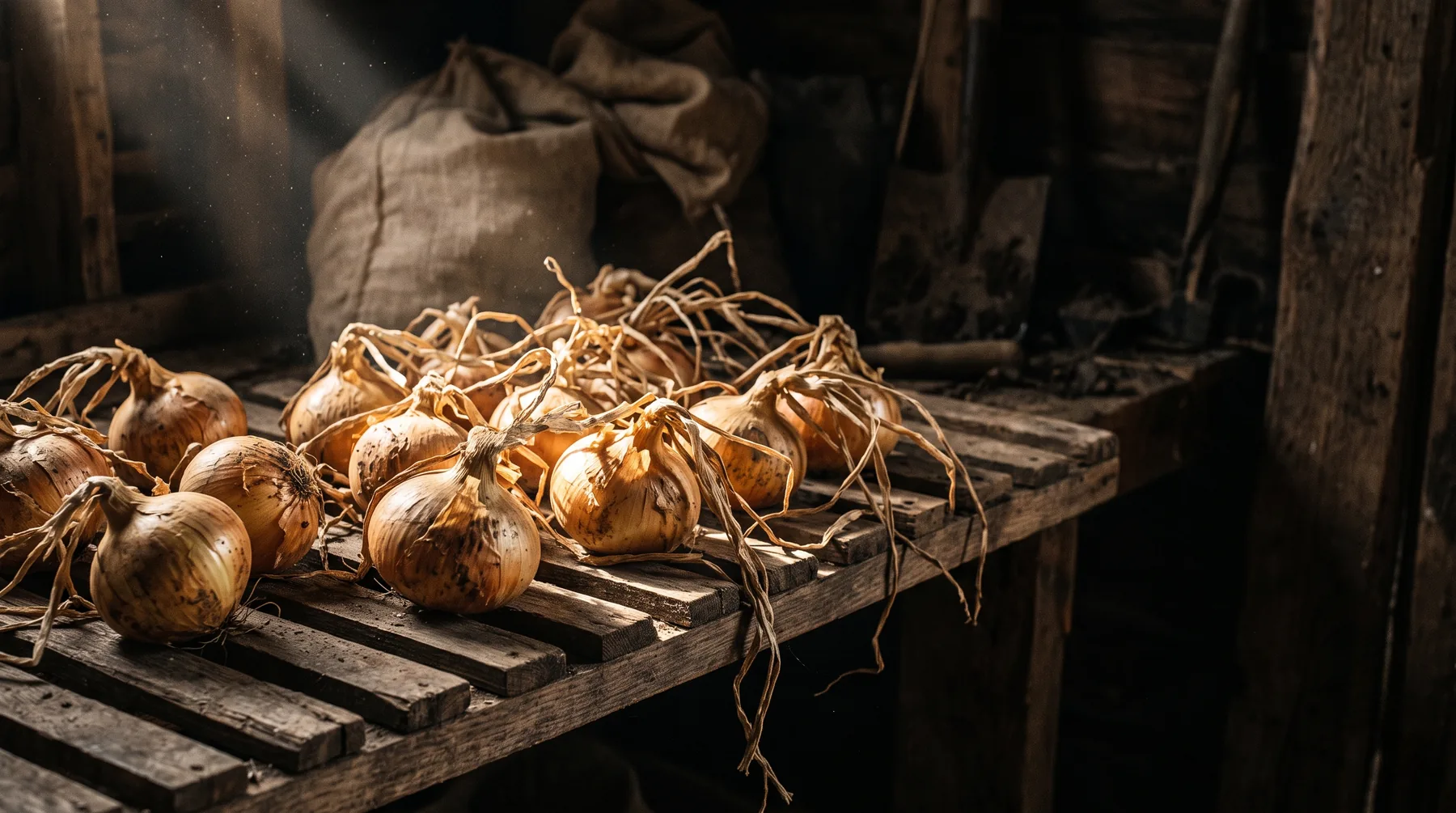
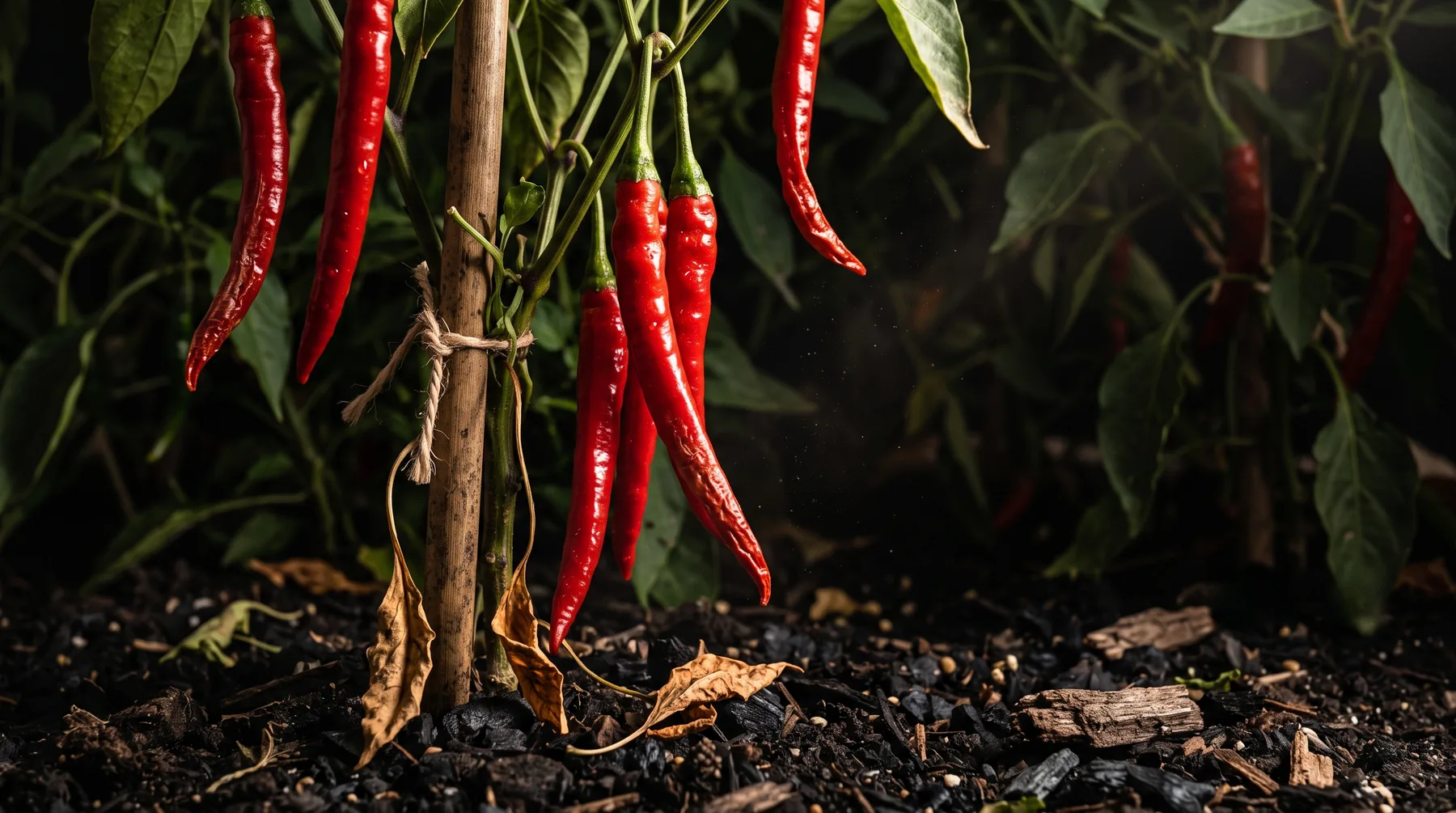
Bottled ketchup is sugar, vinegar and tomato concentrate. This is what it tastes like when the tomato comes first: brick-red, thick, sharp with cider vinegar, and warm with clove, allspice, cinnamon and celery seed. It sits somewhere between the bottle and a chutney, and it makes a burger taste like summer in February.
It’s also one of the few condiments with a tested home-canning process, so the jars live in the cupboard, not the fridge.
What you need
From NCHFP, as tested.
| Ingredient | Tested amount |
|---|---|
| Ripe tomatoes (Roma) | 24 lb |
| Onion, chopped | 3 cups |
| Ground red pepper (cayenne) | 3/4 tsp |
| Cider vinegar, 5% acidity | 3 cups |
| Whole cloves | 4 tsp |
| Cinnamon sticks, crushed | 3 |
| Whole allspice | 1½ tsp |
| Celery seed | 3 tbsp |
| Sugar | 1½ cups |
| Salt | 1/4 cup |
Yield is 6–7 pints.
Method
- Blanch and peel. Dip the tomatoes in boiling water for 30–60 seconds until the skins split, then plunge them into cold water. Slip off the skins and remove the cores. Quarter them into a large stockpot.
- Onion and cayenne in. Bring to a boil and simmer 20 minutes, uncovered.
- Rest. Cover, turn off the heat and let it stand 20 minutes.
- Spice the vinegar. Tie the cloves, cinnamon, allspice and celery seed in a spice bag. Bring it to a boil with the vinegar, then remove the bag.
- Combine and boil. Add the hot spiced vinegar to the tomatoes and boil 30 minutes.
- Mill it. Pass everything through a food mill or sieve and return the purée to the pot.
- Sugar, salt, reduce. Add the sugar and salt and boil gently, stirring often, until the volume is halved or the ketchup rounds up on a spoon without separating. Expect two hours or more. This is the slow part.
- Fill hot pint jars with 1/8-inch headspace. Wipe the rims and fit the lids.
- Process in a boiling-water bath:
| Altitude | Pints |
|---|---|
| 0–1,000 ft | 15 min |
| 1,001–6,000 ft | 20 min |
| Above 6,000 ft | 25 min |
Grow it for the reduction
Ketchup is a reduction sauce, and reduction punishes water. A slicing tomato is mostly juice, so 24 lb of beefsteak means another hour or more at the stove and a thinner result. A determinate Roma is dense paste-tomato flesh, and three plants ripen the whole 24 lb in the same three-week window. That’s one Saturday, not a month of half-batches.
Grow one cayenne for the 3/4 teaspoon of red pepper as well. It’s a tiny amount, but freshly ground home-dried cayenne is noticeably brighter than a jar of powder that’s been open since last year, and the rest of that plant becomes Louisiana hot sauce and a year of flakes.
Spice it your way, but only the spices
Clove, allspice, cinnamon and celery seed ride in a spice bag that comes out of the vinegar before it meets the tomatoes. That makes the bag the one place you can change things freely: add a couple of star anise, a teaspoon of mustard seed, or a few black peppercorns. The vinegar, its 5% strength, the tomatoes and the onion stay exactly as written. For why the acid can’t move, see canning acid math.
Storage
Store sealed jars somewhere cool and dark and use them within a year for best quality. Once a jar is open, keep it in the refrigerator.
The kit for this sauce
Each item is selected for a job in this recipe. Amazon listings, sellers, and prices can change; check the current details before you buy.
Roma Tomato Seed (300+)
The determinate paste tomato: it ripens most of its crop inside a three-week window. That is a liability for eating and an enormous advantage for sauce day.
Yellow Sweet Spanish Onion Seed
A long-day storage onion with enough sugar to sweat down without scorching. The aromatic base under every tomato sauce on this site.
Organic Cayenne (Long Slim) Seed
The long, thin, wall-thin cayenne that dries in a week and grinds to a clean red powder. If you want flakes and powder as well as sauce, this is the plant that does both.
58" Square Tomato Cages, 3-PackMust have
The conical wire tomato ring from the hardware store is 33 inches tall and an indeterminate San Marzano will laugh at it in July. Height and square geometry are what actually hold a loaded plant.
Garden Harvest Basket with Tool Caddy
A harvest basket that doubles as a colander means the hose rinse happens in the garden, and the dirt stays outside. On a 20-pound tomato day that is a genuine time saving.
Digital Kitchen Scale, 11 lb, g/ozMust have
Fermentation brine is a percentage of weight, not a number of spoons. Without a gram scale you are not following a fermentation recipe — you are guessing at the one number that determines whether it is safe.
Stainless Steel Food Mill, 3 discsMust have
A blender pulverises tomato skins and seeds into the sauce, which is where bitterness comes from. A mill separates them out — no blanching, no peeling, no ice bath. It removes an entire hour from sauce day.
One-Touch Coffee & Spice Grinder
Dried cayenne into powder in fifteen seconds. Dedicate one to chiles — grind coffee in it afterwards and you will find out exactly how well capsaicin sticks to plastic.
Gourmet Stainless 12-Quart Stock Pot
For twenty pounds of tomatoes, the Dutch oven is too small. Twelve quarts of non-reactive stainless is the batch-scale vessel, and it doubles as a water-bath canner in a pinch.
Essential Enameled Cast Iron Dutch Oven, 6 qtMust have
Tomato sauce is acidic enough to strip bare cast iron and pick up a metallic tang from aluminium. Enamel is non-reactive, and the thermal mass holds a low simmer for three hours without scorching the bottom.
9-Piece Enamelware Water Bath Canning SetMust have
Water-bath canning is the tested process for high-acid foods — anything reliably below pH 4.6. The rack is not optional: jars sitting on the pot floor crack from direct heat.
Canning Essentials SetMust have
A jar lifter is a safety tool, not a convenience: you are moving glass full of 212 °F sauce. The headspace gauge is the other half — wrong headspace is the most common reason a seal fails.
Pint (16 oz) Regular Mouth Mason Jars with Lids and Bands
The right size for marinara, where a jar is one dinner for a family. Same rules as the half-pints: the glass is forever, the flat lid is not.
Mason Jar Lids, Regular Mouth, 72 countMust have
The flat lid's sealing compound is designed for one heat cycle. Reusing it is the single most common cause of a jar that seals, then quietly unseals in November.
Canning Jar Labels, 360 pcs, removable
Date every jar. In March, three jars of red sauce are indistinguishable, and 'it's probably the one from August' is not a food-safety practice.
Paid links. We earn a commission from Amazon if you buy; you pay the same. Disclosure.
Questions people actually ask
Can I cut the sugar?
The tested recipe calls for 1½ cups, and that's the version NCHFP validated. Sugar is flavour and body here, and the vinegar is the acid barrier. We make it as tested. If you want less sweetness, use more of the spice bag rather than less sugar, and never touch the vinegar.
Why does it take so long to reduce?
Twenty-four pounds of tomato is mostly water, and ketchup has to lose about half its volume after the vinegar goes in. Paste tomatoes start drier than slicers, which is why this page grows Roma. A wide pot reduces faster than a tall one, and stirring is non-negotiable in the last hour, when it starts to catch.
Can I use a blender instead of a food mill?
The food mill is what removes seeds and the last of the skin. A blender pulverises them into the ketchup and turns it bitter and orange. If all you have is a blender, push the purée through a fine sieve afterward.
How do I know it's thick enough?
NCHFP's test is that the volume has reduced by half, or the ketchup rounds up on a spoon without separating. A spoonful on a cold plate shouldn't weep a ring of water.
Can I make it in quarts?
Not with this process. NCHFP gives times for pints only.
Last reviewed 2026-10-17 by the SeedsToSauce Test Kitchen. Spotted something wrong?Tell us — corrections get published.