
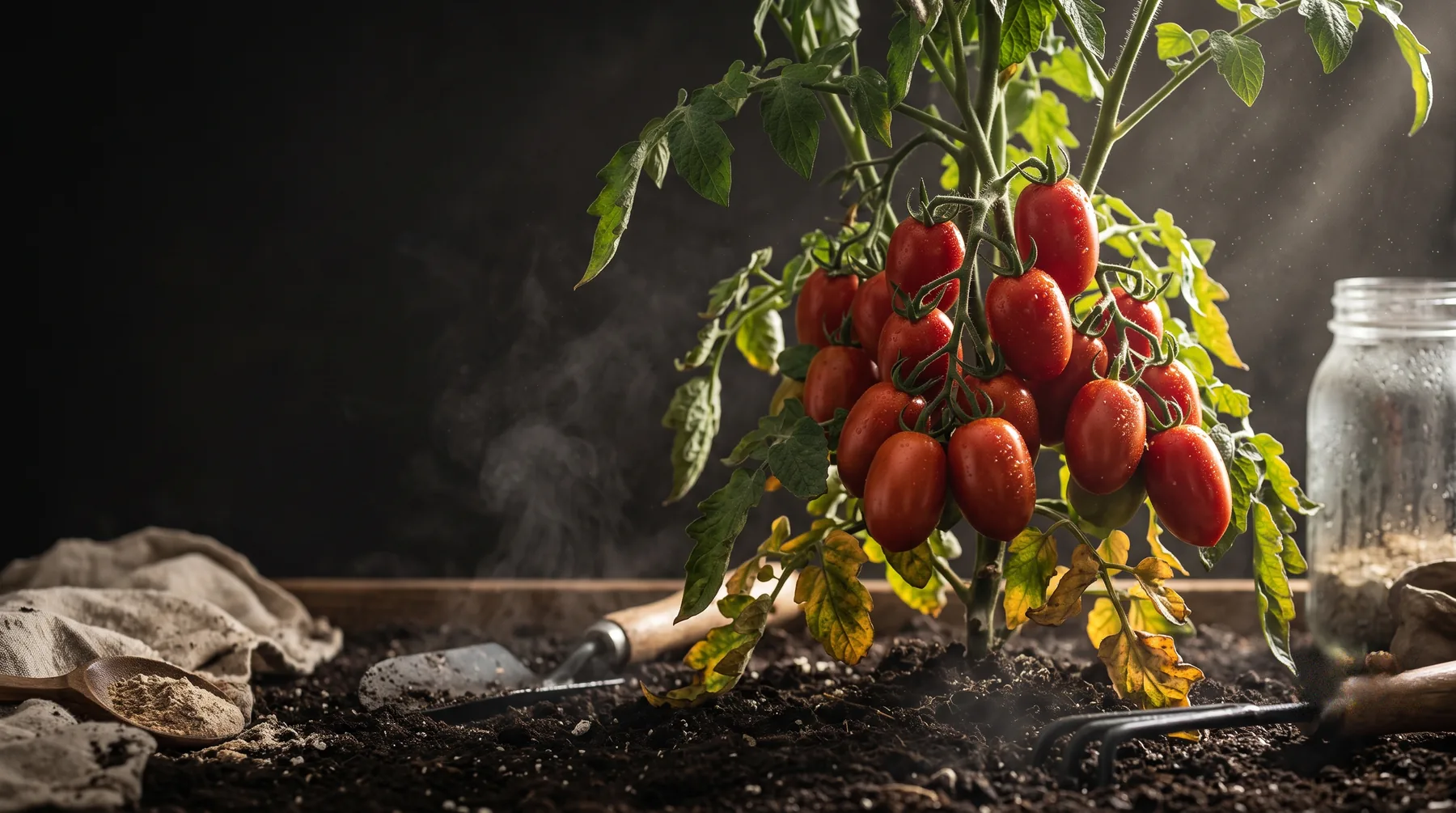
Grow file · Roma VF (determinate paste)
Roma Tomato
Solanum lycopersicum
The determinate paste tomato — it ripens most of its crop in a three-week window, which is a liability for eating and a huge advantage for sauce day.
| Days to maturity | 75 days from transplant |
|---|---|
| Days to germinate | 5–10 days at 78 °F |
| Germination soil temp | 75–85 °F |
| Start indoors | 6 weeks before last frost |
| Transplant | 1 weeks after last frost |
| Spacing | 24″ between plants |
| Sun | 8+ hours direct |
| Container size | 10 gal minimum per plant |
| Realistic yield | 9 lb per healthy plant, per season |
Your dates, by zone
Built from each zone's average last frost and this cultivar's 75-day maturity. Zone averages are not your garden — look up your city's NOAA frost dates or enter your ZIP in the builder to shift every row.
| Zone | Sow indoors | Transplant | First pick |
|---|---|---|---|
| Zone 3 | Apr 3 | May 22 | Aug 5 |
| Zone 4 | Mar 31 | May 19 | Aug 2 |
| Zone 5 | Mar 19 | May 7 | Jul 21 |
| Zone 6 | Mar 10 | Apr 28 | Jul 12 |
| Zone 7 | Feb 20 | Apr 10 | Jun 24 |
| Zone 8 | Feb 14 | Apr 4 | Jun 18 |
| Zone 9 | Jan 17 | Mar 7 | May 21 |
| Zone 10 | Dec 20 | Feb 7 | Apr 23 |
| Zone 11+ | Dec 4 | Jan 22 | Apr 7 |
Tight means first pick lands within two weeks of that zone's average first fall frost. It is doable, with zero slack in the indoor start.
Harvest visual
Ready when you see this
Pick when the fruit is fully red with no green shoulder and gives slightly under thumb pressure. For sauce, harvest the whole flush over several days as fruit moves from orange-red to rich red.
Determinate is a feature here
Every gardening article treats a determinate tomato’s concentrated harvest as a drawback. For fresh eating, it is. For canning, it is exactly the property you want: one sauce day, not eleven weeks of collecting three tomatoes at a time and freezing them.
A Roma sets its fruit, ripens most of it inside about three weeks, and finishes. You process a batch, you clear the bed, you are done.
Roma against San Marzano
| Roma VF | San Marzano | |
|---|---|---|
| Habit | Determinate | Indeterminate |
| Days to maturity | 75 | 80 |
| Yield per plant | ~9 lb | ~12 lb |
| Harvest pattern | One flush, ~3 weeks | Continuous to frost |
| Support | Cage, 4 ft | Cage or weave, 6 ft+ |
| Best for | One big canning day, short seasons | Multiple batches, long seasons |
Both are excellent sauce tomatoes. In Zone 4 or 5, Roma’s five extra days of margin and lower support requirement is often the deciding factor. The “VF” is a disease-resistance designation — verticillium and fusarium wilt — and it is worth having.
Growing
Six weeks indoors, transplant a week after last frost, cage at transplant. It stays around 4 feet, so support is easier than San Marzano but still not optional under a full fruit load.
Same food-mill approach at harvest: no peeling, no blanching, mill everything.
How this crop actually fails
Named, specific, and in the order you're most likely to meet them.
Plant crops heavily then dies back in August
Cause Nothing has gone wrong. Determinate tomatoes set a terminal flower cluster and stop; the plant is finished after its flush.
Fix Plan for it. Sow a second succession three weeks after the first if you want a longer supply.
Blossom end rot across the whole flush
Cause The determinate habit concentrates demand — every fruit is calling for calcium simultaneously, so a watering swing hits all of it at once.
Fix Drip on a timer, established before flowering rather than after you see the damage.
Not enough fruit for a batch despite a healthy plant
Cause Underestimating. A Roma gives about 9 lb, and a 12-lb marinara batch is therefore not one plant.
Fix Grow two, or use the Plan Builder, which does this arithmetic from the recipe's actual weights.
What roma tomato needs
Roma Tomato Seed (300+)
The determinate paste tomato: it ripens most of its crop inside a three-week window. That is a liability for eating and an enormous advantage for sauce day.
Organic Seed Starter Potting MixMust have
Seed-starting mix is not potting soil with a nicer label — it is finer, lighter, and low in nutrients on purpose, because a seedling's first roots want air and moisture, not fertiliser.
Seedling Heat Mat + Digital ThermostatMust have
Peppers germinate on soil temperature, not air temperature. At 65 °F a habanero takes a month and half of them rot; at 85 °F it is up in eight days. The thermostat is the half that matters.
T8 Full-Spectrum Grow Lights, 1 ft 4-packMust have
A south window in March delivers a fraction of the light a pepper seedling needs, and the plant tells you by stretching. Two inches of LED above the canopy for 16 hours a day fixes it permanently.
5-Gallon Fabric Grow Bags, 5-Pack
Fabric pots air-prune roots and drain faster than a plastic pot can, which is the entire reason container tomatoes fail. Five gallons is the honest minimum for a pepper; a tomato wants ten.
Ocean Forest Potting SoilMust have
Pre-charged with enough nutrition to carry a transplant for its first month without feeding, which is exactly the window when most container plants stall.
Organic Tomato-Tone 3-4-6 with 8% CalciumMust have
The NPK ratio is the point: low nitrogen, higher potassium. Feed a tomato a high-nitrogen lawn fertiliser and you get a magnificent six-foot plant with four tomatoes on it.
Rot-Stop Blossom End Rot Concentrate
Blossom end rot is almost never a soil calcium shortage — it is a calcium *transport* failure caused by inconsistent water. A foliar calcium spray buys time while you fix the watering, which is the real cure.
58" Square Tomato Cages, 3-PackMust have
The conical wire tomato ring from the hardware store is 33 inches tall and an indeterminate San Marzano will laugh at it in July. Height and square geometry are what actually hold a loaded plant.
Drip Irrigation System with Timer, 16 Nozzles
Blossom end rot, split tomatoes and bitter fruit all trace back to the same thing: water that swings. A $50 timer removes the human from the loop and removes the swing.
Captain Jack Copper Fungicide, 16 oz
Early blight and septoria arrive with a wet July and work up the plant from the bottom. Copper is preventative — sprayed after you see it, you are already losing.
Stainless Steel Food Mill, 3 discsMust have
A blender pulverises tomato skins and seeds into the sauce, which is where bitterness comes from. A mill separates them out — no blanching, no peeling, no ice bath. It removes an entire hour from sauce day.
Paid links. We earn a commission from Amazon if you buy; you pay the same. Disclosure.
Last reviewed 2026-09-01. Numbers are cultivar-typical, not guarantees —tell us if yours ran different and we'll say so on the page.