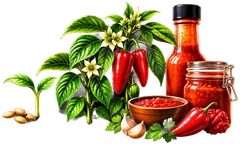
What to make · Cayenne
What to make with Cayenne
3 sauces use Cayenne. Each batch below lists the pounds it uses and the plants that supply it, at 1.8 lb per plant per season. One batch of every sauce on the list takes 3.7 lb. Total pounds divided by yield per plant, rounded up once, is 3 plants.
| Sauce | Cayenne per batch | Plants per batch | Storage |
|---|---|---|---|
| Louisiana CayenneAbout 40 oz (eight 5 oz woozy bottles) | 2.5 lb | 2 | Ferment |
| HarissaAbout 2 cups. Fills two half-pint jars | 1.2 lb | 1 | Refrigerate |
| Tomato KetchupAbout 6–7 pints | 0.03 lb | 1 | Water-bath can (tested process) |
Plants per batch is pounds per batch divided by 1.8 lb per plant, rounded up, with no allowance for crop loss. Pounds per batch come from each recipe's own ingredient weights. Details on the plants per batch calculator.
Grow it
Long Slim Cayenne (Capsicum annuum): 75 days to maturity from transplant, 18 in spacing, target soil temperature 75–85 °F. Read the fullcayenne grow guide, thenbuild a dated plan for your zone, or checkwhen to plant by state.
Frequently asked
How many cayenne plants do I need for one batch of each sauce?
One batch of every sauce below uses 3.7 lb of cayenne. At 1.8 lb per healthy plant per season, total pounds divided by yield per plant, rounded up once, is 3 plants. The per-sauce counts in the table each round up separately, so they can add up to more. The Plan Builder uses the same formula.
Which sauce uses the most cayenne?
Louisiana Cayenne, at 2.5 lb per batch (2 plants).
Which of these sauces have a tested canning process?
Tomato Ketchup follows a USDA/NCHFP tested process. Every other sauce here is stored by the method in its Storage column and has no tested canning process.
What cayenne needs
Organic Cayenne (Long Slim) Seed
The long, thin, wall-thin cayenne that dries in a week and grinds to a clean red powder. If you want flakes and powder as well as sauce, this is the plant that does both.
Organic Seed Starter Potting MixMust have
Seed-starting mix is finer, lighter, and low in nutrients on purpose, because a seedling's first roots want air and moisture, not fertiliser. Potting soil with a nicer label won't do that.
Seedling Heat Mat + Digital ThermostatMust have
Peppers germinate on soil temperature, not air temperature. At 65 °F a habanero takes a month and half of them rot; at 85 °F it is up in eight days. The thermostat is the half that matters.
T8 Full-Spectrum Grow Lights, 1 ft 4-packMust have
A south window in March delivers a fraction of the light a pepper seedling needs, and the plant tells you by stretching. Two inches of LED above the canopy for 16 hours a day fixes it permanently.
5-Gallon Fabric Grow Bags, 5-Pack
Fabric pots air-prune roots and drain faster than a plastic pot can, which is the entire reason container tomatoes fail. Five gallons is the minimum for a pepper; a tomato wants ten.
Ocean Forest Potting SoilMust have
Pre-charged with enough nutrition to carry a transplant for its first month without feeding, which is exactly the window when most container plants stall.
Organic Tomato-Tone 3-4-6 with 8% CalciumMust have
The NPK ratio is the point: low nitrogen, higher potassium. Feed a tomato a high-nitrogen lawn fertiliser and you get a magnificent six-foot plant with four tomatoes on it.
6" Micro-Tip Pruning SnipsMust have
Ninety percent of sauce-garden cutting is snipping a pepper stem or a basil node, and a fine-tipped snip does it better than any pruner. Pulling peppers by hand tears the branch.
Food Dehydrator, 6 Stainless Trays
Sun-drying chiles works in Oaxaca and fails in Ohio, where humidity lets mould win the race. Controlled 125 °F airflow dries a full cayenne harvest overnight, every time.
One-Touch Coffee & Spice Grinder
Dried cayenne into powder in fifteen seconds. Dedicate one to chiles: grind coffee in it afterwards and you will find out exactly how well capsaicin sticks to plastic.
Paid links. We earn a commission from Amazon if you buy; you pay the same. Disclosure.