
Guide · cooking
Texture: milling, blending, straining, and getting it into a bottle
Why a food mill beats a blender for tomato, why a blender beats everything for hot sauce, and how to hit a consistency that actually comes out of a woozy bottle.
Texture is the difference between a sauce people finish and one they use twice. It is decided by which tool you reach for, and the right tool is different for tomato and for chile.
Tomato: a food mill, not a blender
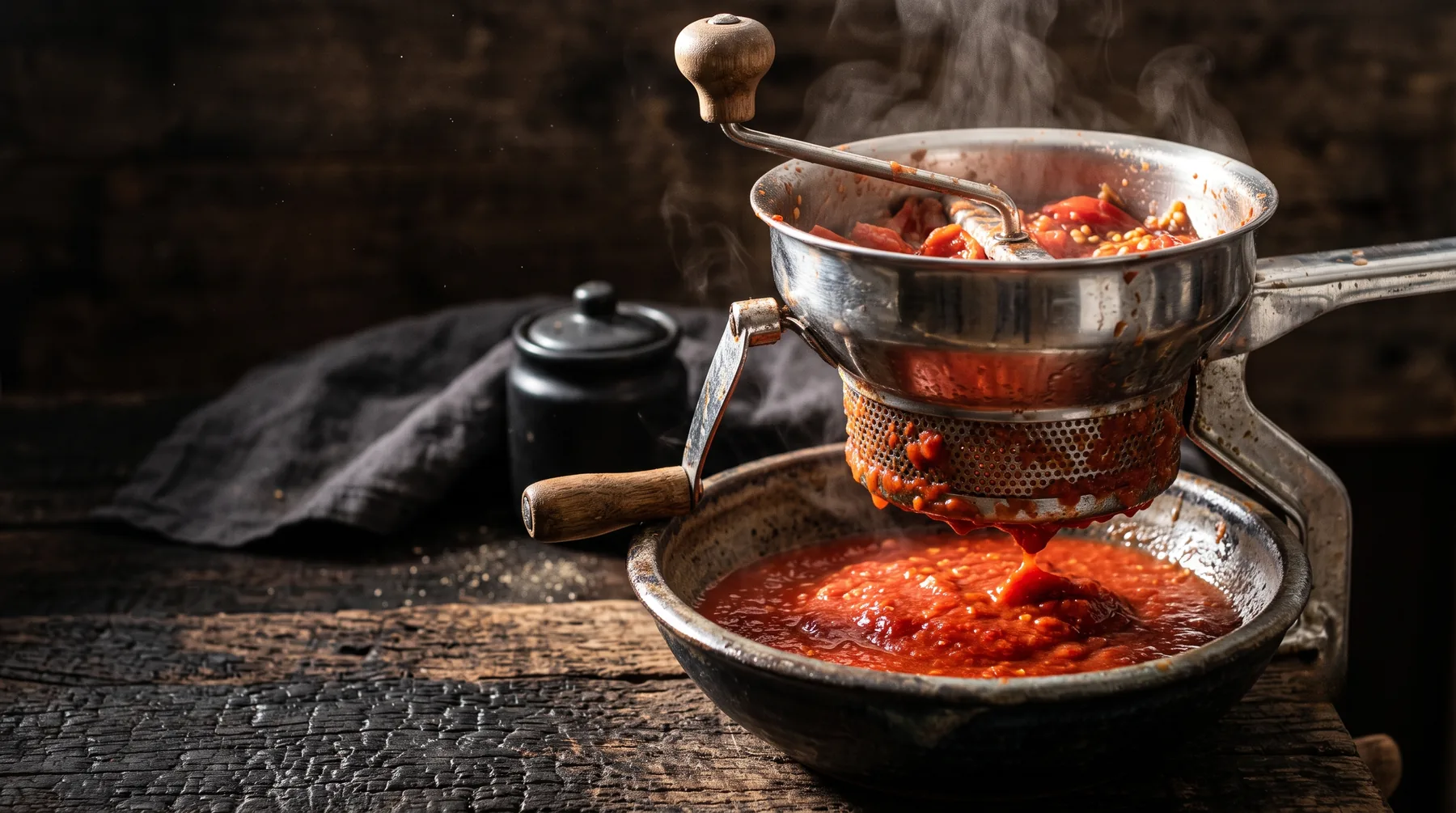
A tomato has two things you do not want in the sauce: skin and seeds. Tomato seeds are actively bitter when their coats are broken, and skin gives a papery grit no amount of cooking removes.
A blender pulverises both into the sauce. A mill separates them out mechanically — you turn a handle and skins and seeds stay in the hopper.
That is not just a quality argument, it is a time argument. With a mill you skip blanching, ice baths and peeling entirely: halve the tomatoes, cook them down, mill everything. That is roughly an hour removed from a 12-pound sauce day.
Disc choice:
- Coarse — rustic, visible texture, for a chunky marinara.
- Medium — the default for a Sunday gravy.
- Fine — smooth, for a passata or a pizza sauce.
Chile: a blender, and a long one
The opposite. For hot sauce you want the chile skin in there — it carries colour and a large share of the flavour — and the goal is to emulsify it so completely that it never settles out.
That takes a genuinely long blend. A full two minutes on high, not fifteen seconds. Under-blending is the single reason home hot sauce separates into two layers in the bottle.
- High-speed blender: emulsifies skin completely. No straining needed, no separation.
- Immersion blender: blends in the pot, which is safer with hot liquid and means fewer transfers — but it will not fully break chile skin. Strain afterward.
- Food processor: wrong tool. It chops; it does not emulsify.
Straining, and what it costs
Straining through fine mesh gives you a thin, clean, pourable Louisiana-style sauce that runs through a dripper insert. It also costs you 10–15% of your volume and some body.
Decide by destination:
| Destination | Strain? |
|---|---|
| Woozy bottle with a dripper | Yes, hard. The insert clogs otherwise. |
| Squeeze bottle | Lightly |
| Jar, spooned | No — the body is the point |
| Canning | Follow the tested recipe exactly |
Push it through with the back of a ladle. Waiting for gravity takes twenty minutes and gets you less.
Thickening — and the rule that is about safety
For a refrigerated sauce, xanthan gum at roughly 0.2% by weight gives a glossy, stable body with no starchy taste. Blend it in at the very end; sprinkle it into the vortex or it clumps instantly.
For anything you intend to can, no thickeners at all. Not xanthan, not cornstarch, not flour.
This is not a texture preference. Thickeners slow convection inside the jar, so heat reaches the centre far more slowly and the cold spot may never reach a lethal temperature within the tested process time. A tested process was validated on the un-thickened food. Thicken it and the process no longer applies. See the acid math.
The better approach is reduction: simmer longer and let water leave.
Non-reactive pans, always
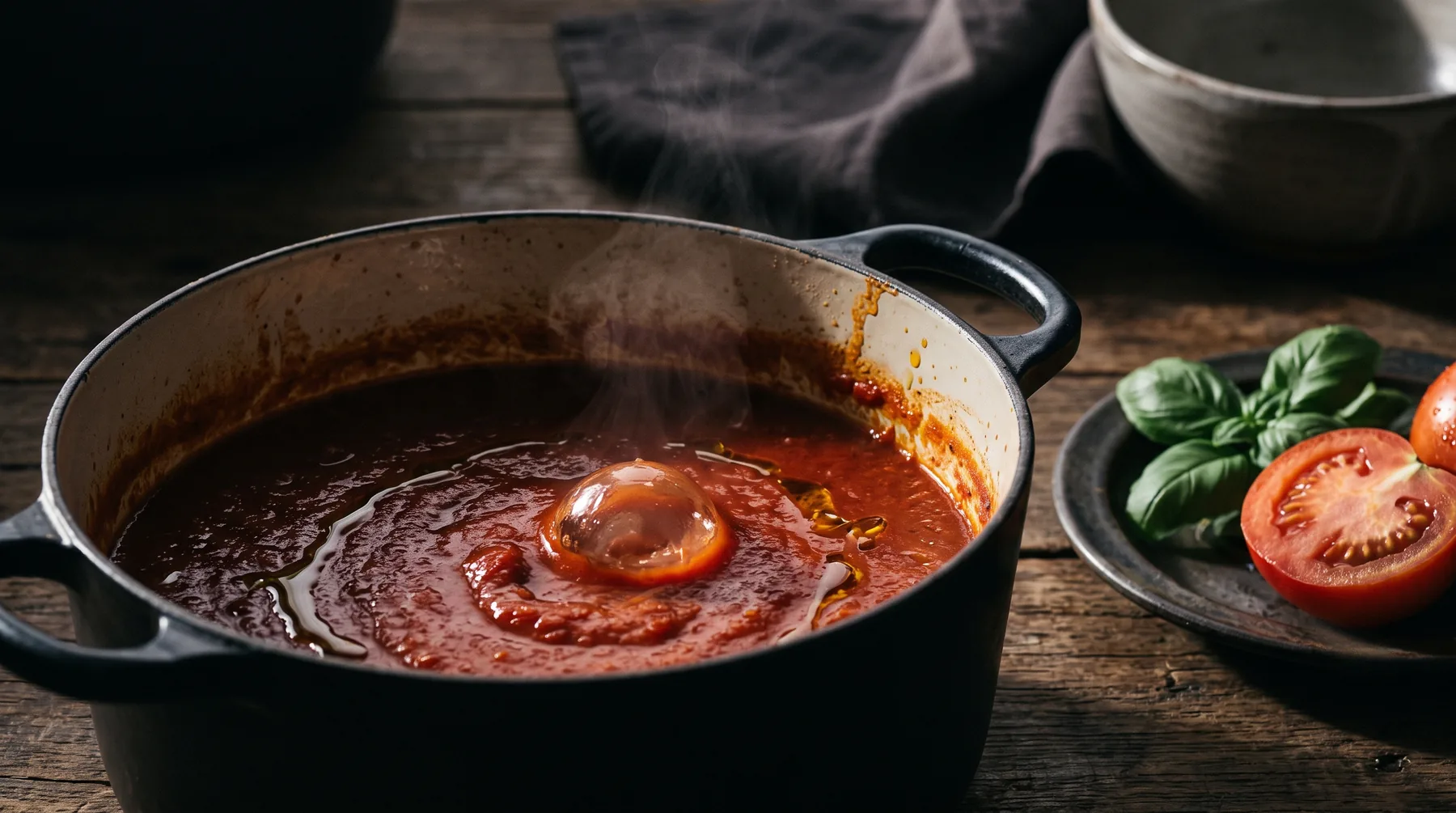
Tomato and vinegar are acidic enough to strip bare cast iron and pull a metallic tang out of raw aluminium — and to pick up a grey cast from both.
Use enamelled cast iron or stainless steel. Nothing else, for anything acidic, ever.
Bottling
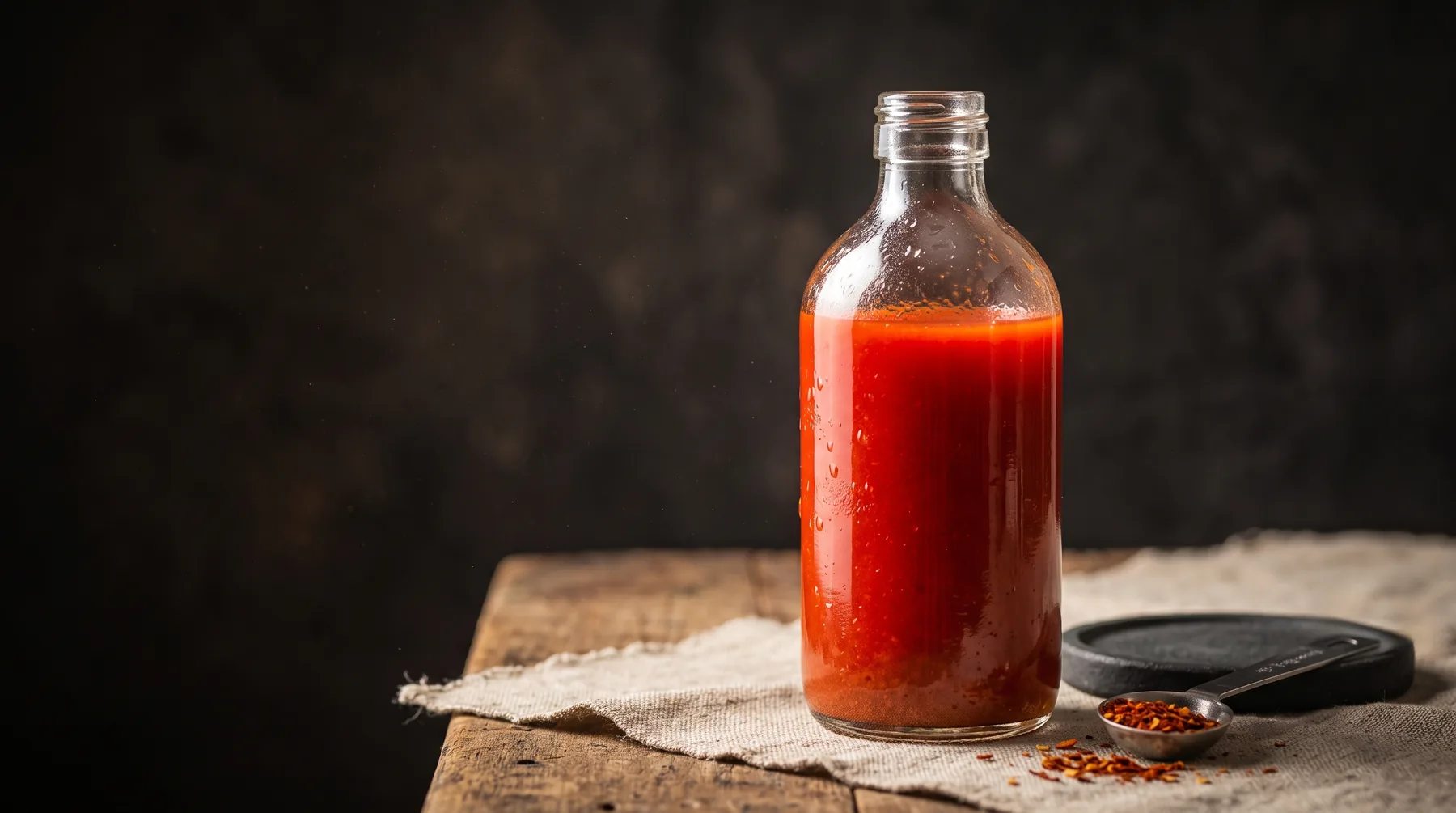
- Sterilise the bottles. Ten minutes in boiling water, or a dishwasher sanitise cycle. A woozy bottle is not a canning jar and will not be processed, so this is your only kill step.
- Fill hot, through a funnel, leaving about half an inch.
- Dripper insert, then cap.
- Label with the date. In March, three red bottles are indistinguishable.
- Refrigerate anything that is not a tested shelf-stable process.
Woozy bottles hold 5 oz, which is the right size — a hot sauce you open should be finished while it is still good, not aged for a year in the door of the fridge.
Related crops
Related sauces
Sources
Every food-safety number on this page traces to one of these. If you are going to trust one link on this site, trust these over us.
The gear this guide assumes
Stainless Steel Food Mill, 3 discsMust have
A blender pulverises tomato skins and seeds into the sauce, which is where bitterness comes from. A mill separates them out — no blanching, no peeling, no ice bath. It removes an entire hour from sauce day.
5200 Professional-Grade Blender, 64 oz
The difference between a hot sauce that is smooth and one that is smooth-ish is blade tip speed. A Vitamix emulsifies chile skin into the sauce so completely you do not need to strain it.
Variable Speed Hand Blender KHBV53
Blends the sauce in the pot it cooked in. No transferring boiling liquid to a jug, no splitting a batch, no second vessel to wash — and for a rustic marinara it is the *right* texture, not a compromise.
Mesh Strainers, Stainless, 3-Count
The last pass before bottling. A fine mesh catches the skin fragments and seed shards that make a hot sauce gritty and clog a woozy bottle's dripper insert.
Essential Enameled Cast Iron Dutch Oven, 6 qtMust have
Tomato sauce is acidic enough to strip bare cast iron and pick up a metallic tang from aluminium. Enamel is non-reactive, and the thermal mass holds a low simmer for three hours without scorching the bottom.
Gourmet Stainless 12-Quart Stock Pot
For twenty pounds of tomatoes, the Dutch oven is too small. Twelve quarts of non-reactive stainless is the batch-scale vessel, and it doubles as a water-bath canner in a pinch.
Woozy Hot Sauce Bottles, 5 oz, 24-PackMust have
A hot sauce in a mason jar is a condiment you spoon. In a woozy bottle with a dripper insert it is a hot sauce — and dripper control is the difference between seasoning food and ruining it.
Half Pint (8 oz) Regular Mouth Mason Jars, 12Must have
Eight ounces is the right jar for a sauce you use by the spoonful. Open a quart of hot sauce and you are racing the fridge; open a half-pint and you finish it while it is still good.
Canning Jar Labels, 360 pcs, removable
Date every jar. In March, three jars of red sauce are indistinguishable, and 'it's probably the one from August' is not a food-safety practice.
Paid links. We earn a commission from Amazon if you buy; you pay the same. Disclosure.
Questions people actually ask
Can I just use a blender for tomato sauce?
You can, and it will be slightly bitter and slightly gritty. A blender pulverises skins and seeds into the sauce; tomato seeds in particular are bitter when broken. A mill separates them mechanically. If a blender is all you have, peel and seed first — which is the hour of work the mill exists to eliminate.
My hot sauce separates in the bottle.
Under-blended. Chile skin needs a genuinely long, high-speed blend — a full two minutes — to emulsify into the liquid. A short blend leaves suspended particles that settle out. Shaking before use is normal for an unfiltered sauce, but a hard separation into two layers means blend longer next time.
Can I add cornstarch or xanthan to thicken it?
For a refrigerated sauce, xanthan at about 0.2% by weight works well and is what commercial producers use. For anything you intend to CAN, no — thickeners slow heat penetration so the cold spot in the jar may never reach lethal temperature. This is a genuine safety rule, not a texture preference.
Why won't my sauce come out of the woozy bottle?
It's too thick, or it wasn't strained. A dripper insert needs a genuinely thin, particle-free sauce. Strain hard through fine mesh and thin with brine or vinegar. A thick sauce belongs in a jar, not a woozy.
Last reviewed 2026-09-01 by the SeedsToSauce Test Kitchen.Corrections welcome.